
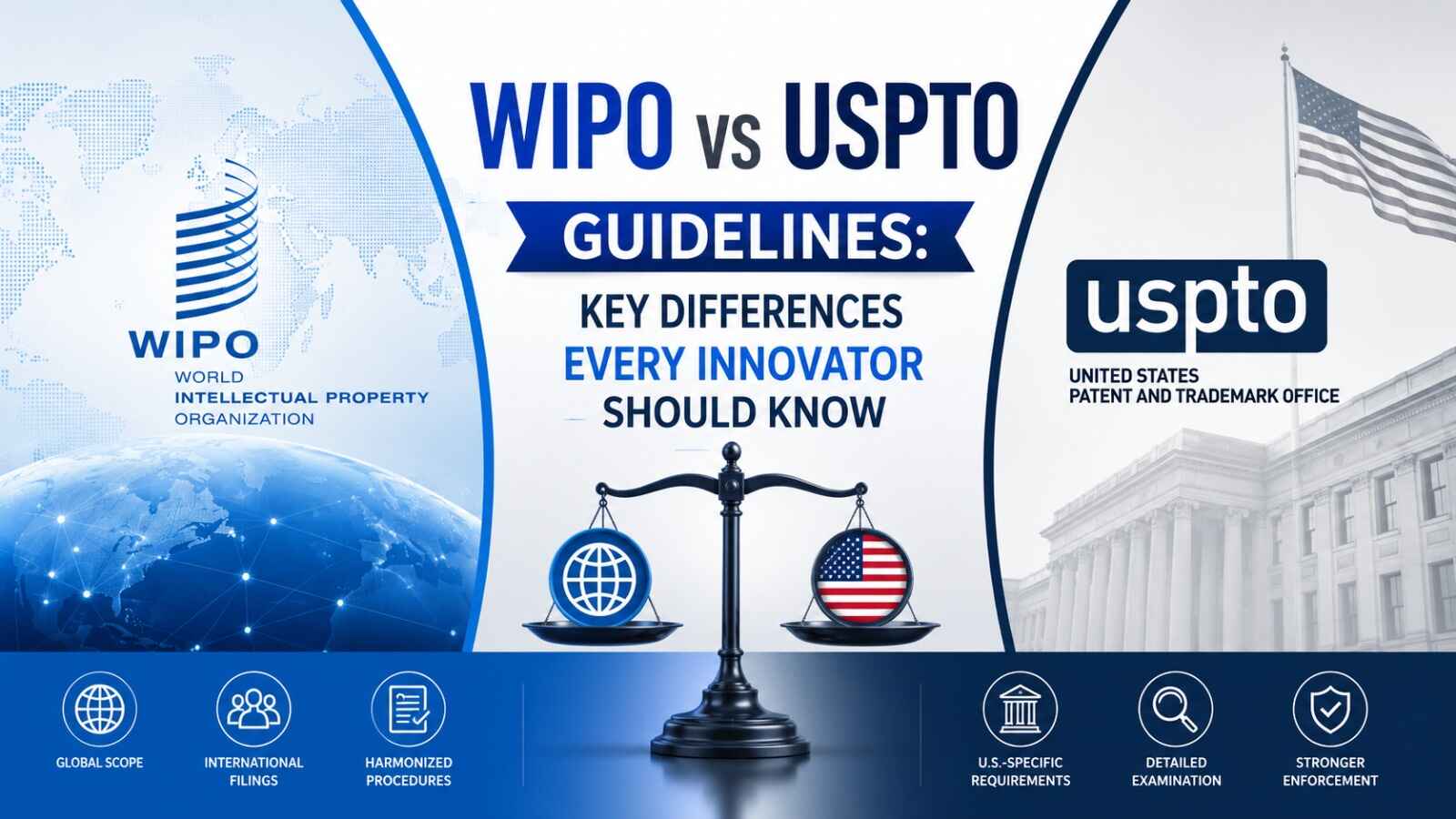
When protecting an invention internationally, understanding WIPO vs USPTO Guidelines is essential. Inventors, startups, research organizations, and businesses often struggle to decide whether to file directly with the United States Patent and Trademark Office (USPTO) or use the World Intellectual Property Organization (WIPO) through the Patent Cooperation Treaty (PCT). While both organizations play significant roles in intellectual property protection, their objectives, procedures, and filing requirements differ considerably.
Understanding WIPO vs USPTO Guidelines helps inventors choose the right filing strategy, reduce delays, improve patent quality, and maximize global patent protection. Whether you are filing your first patent application or expanding your innovation into international markets, selecting the right approach is critical.
At IP Brigade, we help inventors and businesses navigate patent filing strategies through comprehensive IP research, patent searches, patent drawings, and technical support that strengthens every stage of the patent process.
Understanding WIPO and USPTO
Before comparing WIPO vs USPTO Guidelines, it’s important to understand what each organization does.
What is WIPO?
The World Intellectual Property Organization (WIPO) is a specialized agency of the United Nations that promotes international intellectual property protection. WIPO administers several international treaties, including the Patent Cooperation Treaty (PCT), allowing inventors to seek patent protection in multiple countries using one international application.
WIPO itself does not grant patents. Instead, it simplifies the international filing process before applications enter individual national patent offices.
What is USPTO?
The federal organization in charge of issuing patents and registering trademarks in the US is the United States Patent and Trademark Office (USPTO).
USPTO examines patent applications according to U.S. patent law and determines whether an invention meets the requirements of:
- Novelty
- Non-obviousness
- Utility
- Proper disclosure
- Patent eligibility
Unlike WIPO, USPTO has authority to grant enforceable U.S. patents.
WIPO vs USPTO Guidelines: Major Differences
Understanding WIPO vs USPTO Guidelines allows applicants to build a filing strategy that matches their business goals.
Feature | WIPO | USPTO |
Purpose | International filing system | National patent office |
Grants Patent | No | Yes |
Coverage | Multiple countries | United States only |
Filing System | Patent Cooperation Treaty (PCT) | U.S. Patent Application |
Examination | International Search & Preliminary Examination | Full Patent Examination |
Patent Rights | National phase required | U.S. Patent granted directly |
These distinctions form the foundation of WIPO vs USPTO Guidelines.
Filing Process Under WIPO
The WIPO filing process generally follows these steps:
Step 1: File an International PCT Application
Applicants submit one international application.
Step 2: International Search
An International Searching Authority performs a prior art search.
Step 3: Written Opinion
Applicants receive an opinion regarding novelty, inventive step, and industrial applicability.
Step 4: Publication
About eighteen months after the priority date, the application is published.
Step 5: National Phase Entry
Applicants choose countries where patent protection is desired.
This flexible international process is one of the major advantages discussed in WIPO vs USPTO Guidelines.
Filing Process Under USPTO
The USPTO process is more direct.
Prepare Patent Application
Applicants prepare:
- Specification
- Claims
- Abstract
- Patent drawings
- Inventor information
File Application
Applications may be:
- Provisional
- Non-Provisional
Examination
A USPTO examiner reviews:
- Patentability
- Prior art
- Formal requirements
Office Actions
Applicants respond to examiner objections.
Patent Grant
If approved, the USPTO grants a U.S. patent.
Understanding these procedures is essential when comparing WIPO vs USPTO Guidelines.
Patent Examination Standards
One important comparison in WIPO vs USPTO Guidelines involves examination.
USPTO examiners evaluate:
- Novelty
- Inventive step
- Utility
- Subject matter eligibility
- Written description
- Enablement
WIPO itself does not issue final patent decisions but provides:
- International Search Report (ISR)
- Written Opinion
- International Preliminary Examination (optional)
National offices ultimately decide patentability.
Patent Drawings Requirements
Patent drawings are essential under both systems.
USPTO requires drawings that clearly disclose the invention according to strict formatting rules.
Similarly, WIPO applications filed under the PCT also require compliant patent drawings if necessary to understand the invention.
Common drawing requirements include:
- Black and white line drawings
- Proper reference numerals
- Consistent views
- No unnecessary shading unless permitted
- High clarity and readability
Professional patent drawings significantly improve application quality under both WIPO vs USPTO Guidelines.
Prior Art Search Importance
One of the biggest mistakes inventors make is filing without conducting prior art research.
A professional search helps determine:
- Novelty
- Existing patents
- Published applications
- Technical literature
- Potential infringement risks
Whether filing under WIPO or USPTO, strong prior art research increases filing confidence.
Timeline Comparison
Another major topic in WIPO vs USPTO Guidelines is timing.
WIPO Timeline
- International filing
- Search report
- Publication
- National phase (typically 30–31 months)
USPTO Timeline
- Direct filing
- Examination
- Office Actions
- Grant or rejection
Applicants seeking broader international protection often appreciate the additional time offered by the PCT route.
Cost Comparison
Costs vary significantly.
USPTO
Lower initial filing costs.
However, protection is limited to the United States.
WIPO
Higher initial filing fees.
But applicants gain additional time before deciding which countries to pursue.
Understanding filing costs is another important factor in WIPO vs USPTO Guidelines.
When Should You Choose USPTO?
Direct USPTO filing is often suitable when:
- The invention will be commercialized only in the U.S.
- Budget is limited.
- Fast U.S. protection is desired.
- International filing is not immediately planned.
When Should You Choose WIPO?
The PCT route is beneficial when:
- International expansion is planned.
- Investors require broader IP protection.
- Multiple countries may become future markets.
- Additional time is needed before selecting jurisdictions.
This flexibility explains why many global companies begin with the WIPO route.
Common Mistakes Applicants Make
Understanding WIPO vs USPTO Guidelines helps avoid mistakes such as:
- Filing without a novelty search
- Poor patent drawings
- Weak claims
- Missing filing deadlines
- Selecting the wrong filing strategy
- Ignoring international protection opportunities
- Inadequate prior art analysis
Professional guidance greatly reduces these risks.
Why Patent Searches Matter Before Filing
Before investing in patent prosecution, businesses should conduct comprehensive searches.
These searches identify:
- Existing patents
- Similar technologies
- Competitor filings
- Market opportunities
- Licensing possibilities
A thorough search also strengthens drafting strategy.
How IP Brigade Supports Your Patent Journey
Choosing between WIPO and USPTO requires more than understanding filing procedures. It requires reliable technical research and accurate documentation.
IP Brigade provides professional intellectual property support for inventors, law firms, research institutions, startups, and enterprises worldwide.
Our experienced team delivers high-quality search reports and technical documentation that improve filing confidence and reduce prosecution risks.
Why Choose an IP Brigade?
IP Brigade combines experienced patent professionals, advanced search methodologies, and global patent database expertise to deliver reliable intellectual property solutions.
Our commitment includes:
- Accurate technical research
- Comprehensive patent search reports
- Fast turnaround
- Global patent database coverage
- High-quality patent drawings
- Cost-effective solutions
- Confidential handling of inventions
- Support for inventors, attorneys, and businesses worldwide
Whether you are preparing a U.S. filing or planning an international patent strategy, IP Brigade helps you make informed decisions backed by data and technical expertise.
Conclusion
Understanding WIPO vs USPTO Guidelines is one of the most important steps in building an effective patent strategy. While USPTO offers direct protection within the United States, WIPO provides a streamlined pathway toward international patent protection through the Patent Cooperation Treaty.
The right choice depends on your commercialization plans, target markets, budget, and long-term business objectives. By understanding WIPO vs USPTO Guidelines, inventors can avoid costly mistakes, improve patent quality, and create stronger global intellectual property portfolios.
A successful patent application also depends on comprehensive prior art research, accurate patent drawings, and well-prepared documentation.
Ready to strengthen your patent strategy?
IP Brigade offers end-to-end intellectual property support to help innovators protect their ideas with confidence. Our specialized services include:
- Novelty Search
- Freedom to Operate Search
- Patent Invalidity Search
- Patentability Search
- Patent Landscape Studies
- Chemical Structure-based Search
- Patent Drawings
Whether you’re filing under WIPO, USPTO, or both, IP Brigade provides the research, analysis, and technical expertise you need to make informed decisions and accelerate your innovation journey. Contact IP Brigade today to discover how our IP solutions can help secure your competitive advantage.