
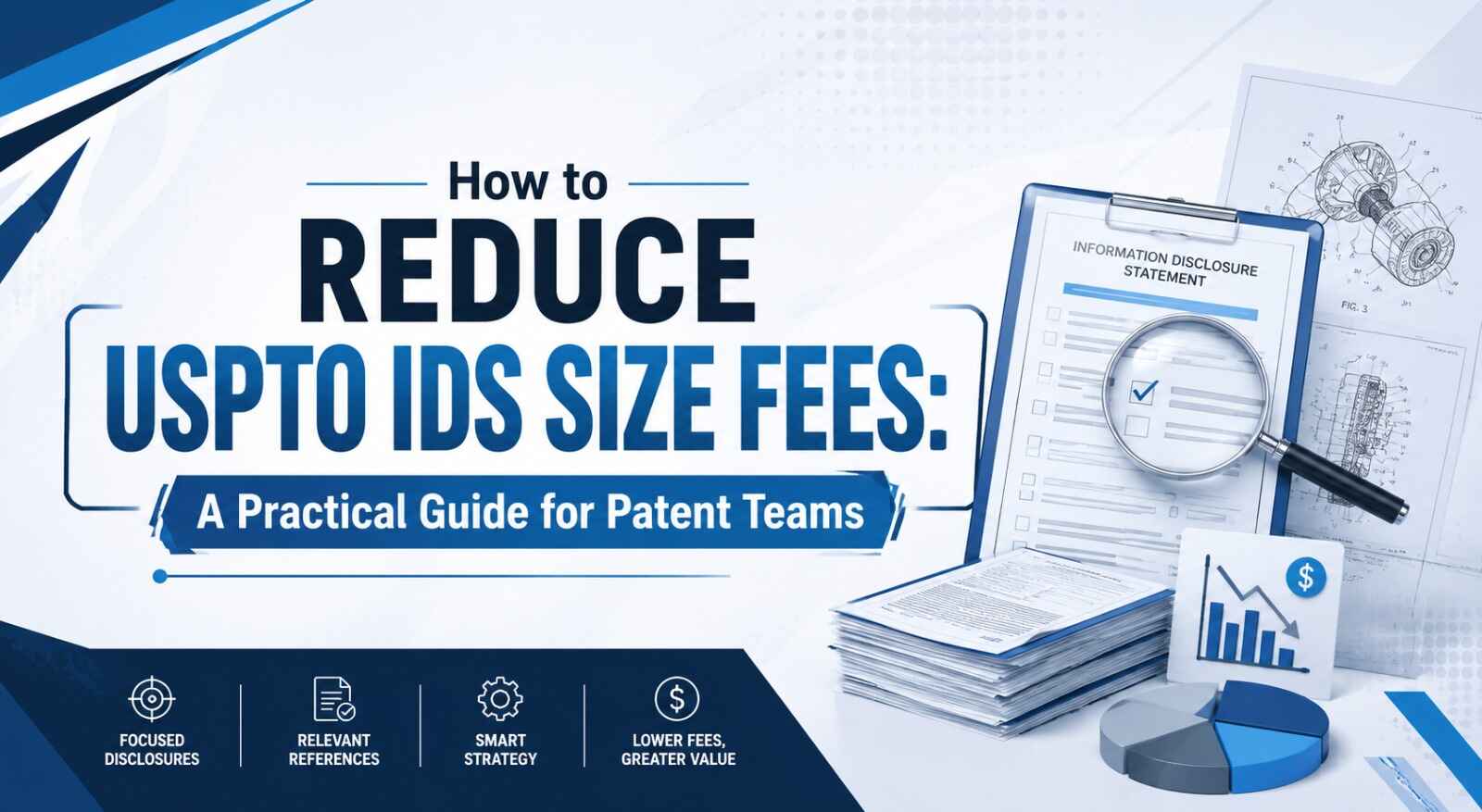
USPTO IDS Size Fees have become an important consideration for patent applicants, in-house counsel, inventors, and IP professionals. As patent portfolios continue to grow, many patent applications require large Information Disclosure Statements (IDS) containing dozens or even hundreds of references. While submitting relevant prior art is essential for compliance with the duty of disclosure, unnecessarily large IDS submissions can increase costs, create administrative burdens, and slow internal patent workflows.
This Practical Guide for Patent Teams explains how to reduce USPTO IDS Size Fees through better prior art management, smarter disclosure strategies, and efficient patent portfolio practices. It also highlights how international patent offices such as the USPTO, EPO, and WIPO influence prior art documentation and why a strategic approach can reduce expenses without compromising patent quality.
Understanding USPTO IDS Size Fees
An Information Disclosure Statement (IDS) is a document filed with the USPTO that identifies patents, published patent applications, and other relevant references known to the applicant that may affect patentability.
The United States patent system requires applicants to comply with the duty of candor and good faith by disclosing material prior art. However, when an IDS contains an unusually large number of references, additional review requirements and administrative obligations may arise. These additional requirements are commonly associated with USPTO IDS Size Fees, making efficient IDS management increasingly important for patent teams.
As innovation becomes more global, companies often cite references generated during prosecution before the EPO, WIPO, and other patent offices. Without careful planning, duplicate references and unnecessary citations can significantly increase the size of an IDS.
Why Patent Teams Should Focus on IDS Management
Many organizations treat IDS preparation as a routine administrative task. In reality, it is a critical part of patent prosecution that affects both costs and efficiency.
A well-organized IDS process helps patent teams:
- Reduce unnecessary filing expenses
- Improve prosecution efficiency
- Avoid duplicate prior art submissions
- Simplify examiner review
- Maintain compliance with USPTO disclosure requirements
- Improve portfolio management across jurisdictions
This is why every organization should have a Practical Guide for Patent Teams that establishes clear internal procedures for preparing and reviewing IDS submissions.
Common Reasons IDS Size Continues to Grow
Understanding why IDS documents become excessively large is the first step toward reducing USPTO IDS Size Fees.
Duplicate References
Patent families often generate multiple search reports from the USPTO, EPO, and WIPO. Many of these reports cite identical references. Without proper review, the same documents are repeatedly disclosed.
Multiple Related Applications
Continuation, divisional, and continuation-in-part applications frequently inherit prior art from earlier filings. Over time, duplicate citations accumulate across the portfolio.
Large International Patent Portfolios
Global applicants prosecute inventions in several countries simultaneously. Search reports issued by different patent offices often include overlapping references, leading to oversized IDS filings.
Lack of Internal Coordination
Engineering teams, outside counsel, inventors, and IP managers sometimes submit references independently. Without centralized review, unnecessary references are added to the IDS.
Practical Guide for Patent Teams to Reduce USPTO IDS Size Fees
Reducing USPTO IDS Size Fees does not mean omitting relevant prior art. Instead, it means improving the way references are collected, organized, and reviewed.
1. Build a Centralized Prior Art Database
Instead of maintaining reference lists for each application separately, establish one centralized database.
Benefits include:
- Eliminating duplicate references
- Faster IDS preparation
- Improved consistency
- Easier portfolio management
- Better collaboration between patent professionals
A centralized database allows patent teams to identify references already disclosed in related applications.
2. Remove Duplicate Patent References
Before filing any IDS, compare all references carefully.
Many applicants unknowingly cite:
- The same patent publication multiple times
- Equivalent family members
- Duplicate foreign publications
- References already disclosed in parent applications
Removing duplicates is one of the simplest ways to reduce USPTO IDS Size Fees while maintaining full compliance.
3. Coordinate Global Patent Prosecution
Companies filing through the USPTO, EPO, and WIPO often receive search reports from multiple jurisdictions.
Rather than automatically submitting every cited document, patent teams should review:
- Whether the reference has already been disclosed
- Whether an equivalent document exists
- Whether the reference is material to patentability
International coordination significantly reduces unnecessary IDS volume.
4. Establish Internal Review Procedures
Every organization should define clear IDS review responsibilities.
A structured workflow may include:
- Initial reference collection
- Duplicate identification
- Materiality review
- Attorney approval
- Final IDS preparation
This systematic approach minimizes errors while reducing filing costs.
5. Conduct Better Prior Art Searches Early
One reason IDS filings become excessive is that references are discovered throughout prosecution.
Comprehensive searches conducted before filing often produce a well-organized prior art set that can be reused consistently.
Professional search providers help applicants identify the most relevant references before prosecution begins, reducing later administrative work.
How Professional Patent Searches Support Smaller IDS Filings
Quality prior art searches contribute significantly to efficient IDS preparation.
Instead of accumulating references from multiple later-stage examinations, applicants begin prosecution with a focused understanding of existing technology.
This reduces unnecessary disclosures while improving examination quality.
At IP Brigade, experienced professionals assist innovators with comprehensive intellectual property support, including:
- Novelty Search
- Freedom to Operate Search
- Patent Invalidity Search
- Patentability Search
- Patent Landscape Studies
- Chemical Structure-based Search
- Patent Drawings
These services help patent teams make informed filing decisions, improve prior art management, and support more efficient patent prosecution across the USPTO, EPO, and WIPO.
Use Patent Analytics to Control IDS Growth
Modern patent teams increasingly rely on patent analytics to monitor disclosure practices and identify unnecessary references before filing. Analytics tools can compare patent families, identify duplicate citations, and organize prior art based on relevance.
By reviewing citation trends across a portfolio, teams can make better decisions about which references should be included in an IDS. This proactive approach not only helps reduce USPTO IDS Size Fees but also creates a more efficient prosecution strategy.
Organizations managing large patent portfolios should periodically audit their IDS filing practices. Regular audits reveal recurring issues, such as duplicate submissions, outdated references, or inconsistent documentation, allowing patent teams to improve future filings.
Leverage Collaboration Between Inventors and Patent Professionals
Effective communication between inventors, engineers, patent attorneys, and IP managers plays a significant role in controlling IDS size.
Inventors often possess valuable technical knowledge that helps identify the most relevant prior art early in the invention process. Patent professionals can then evaluate these references for materiality before they become part of an IDS.
A collaborative review process ensures that only meaningful references are submitted while maintaining compliance with USPTO disclosure obligations. This approach supports a more organized workflow and contributes to reducing USPTO IDS Size Fees.
Develop a Standard IDS Review Checklist
Every patent department should maintain a standardized checklist before submitting an Information Disclosure Statement.
An effective checklist should include:
- Verify whether each reference has already been cited.
- Remove duplicate patent family members.
- Confirm the relevance of every non-patent literature reference.
- Review citations from related U.S. applications.
- Compare references from USPTO, EPO, and WIPO search reports.
- Ensure all required documents are properly identified.
- Obtain attorney approval before filing.
Following a consistent review process reduces administrative errors and supports efficient patent prosecution.
Common Mistakes That Increase USPTO IDS Size Fees
Many applicants unknowingly increase USPTO IDS Size Fees by following outdated or inefficient filing practices. Avoiding these common mistakes can significantly improve portfolio management.
Submitting Every Available Reference
Some applicants believe that including every document ever identified is the safest option. While disclosure obligations are important, filing unnecessary duplicate references increases workload without providing additional value.
Ignoring Foreign Search Reports
Search reports issued by the EPO or WIPO frequently contain references already cited during U.S. prosecution. Reviewing these reports carefully helps eliminate duplicate disclosures.
No Portfolio-Wide Coordination
When multiple outside firms or internal teams manage different applications, inconsistent IDS preparation often leads to repeated citations across related patent families.
Delaying Prior Art Review
Waiting until prosecution is underway to organize references often results in rushed IDS submissions and larger filing packages. Early planning allows patent teams to maintain better control over disclosures.
Building an Efficient Global Patent Strategy
Patent prosecution rarely occurs in only one jurisdiction. Companies seeking international protection must coordinate filings across multiple patent offices while maintaining consistent disclosure practices.
A global strategy should include:
- Early prior art identification.
- Centralized reference management.
- Regular communication among international counsel.
- Standardized IDS preparation procedures.
- Continuous monitoring of patent family developments.
Whether applications are filed before the USPTO, the EPO, or through the WIPO Patent Cooperation Treaty (PCT) system, organized reference management helps reduce unnecessary duplication and improves prosecution efficiency.
Final Thoughts
Managing USPTO IDS Size Fees is not simply about reducing the number of references submitted. It is about developing a structured process that balances legal compliance with operational efficiency. Patent teams that invest in organized prior art management, standardized review procedures, and early patent searching are better positioned to control costs while maintaining strong patent applications.
This Practical Guide for Patent Teams demonstrates that careful planning, international coordination, and effective collaboration can significantly improve IDS preparation. As patent portfolios continue to expand across the USPTO, EPO, and WIPO, adopting smarter disclosure practices becomes increasingly important.
By combining strategic portfolio management with professional intellectual property support from IP Brigade, organizations can reduce administrative burdens, improve prosecution quality, and create a more efficient patent filing process for the future.