
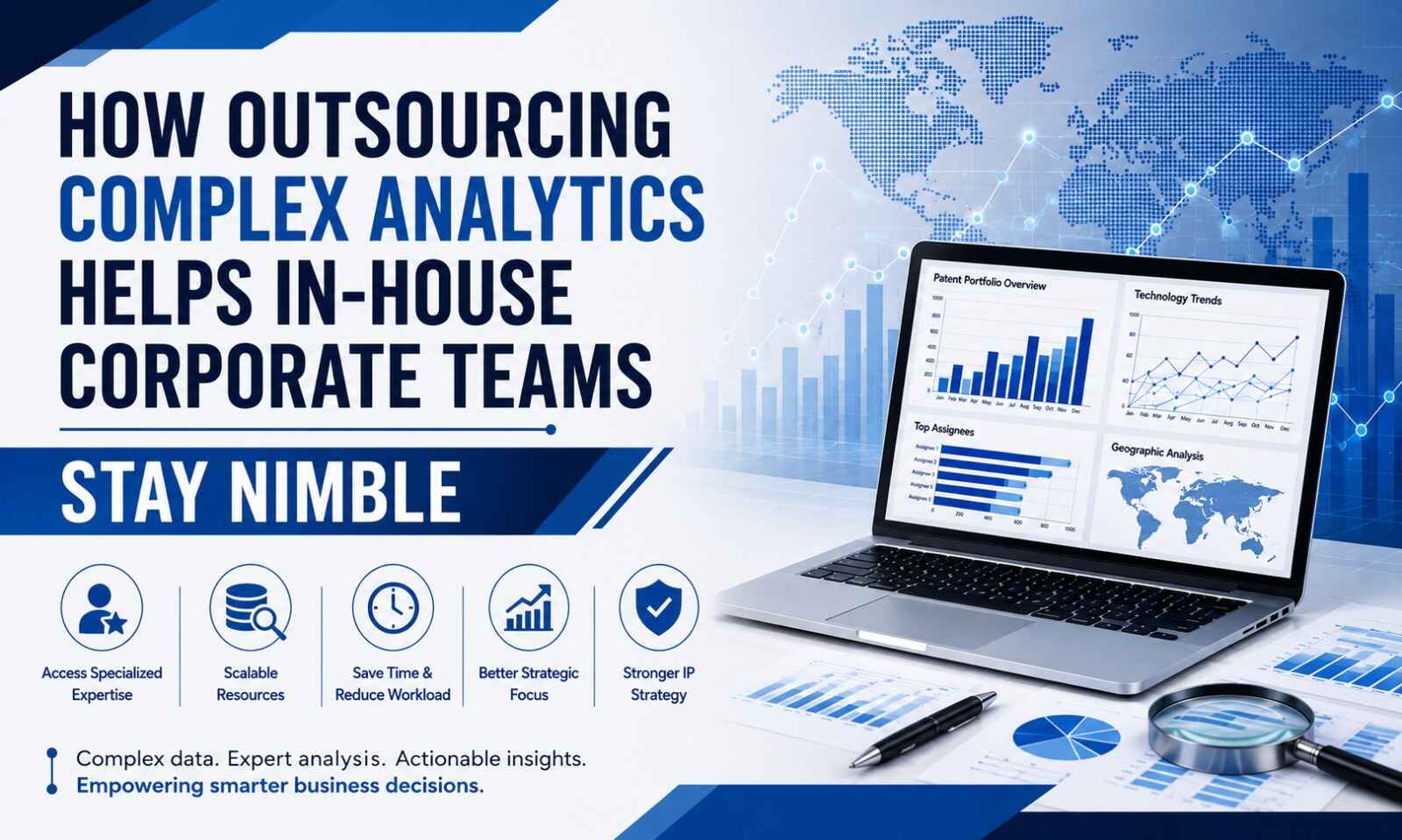
Outsourcing patent analytics helps corporate IP teams manage complex patent data, identify technology trends, and make faster business decisions without increasing the workload of their internal staff. As companies expand their patent portfolios and compete in fast-moving technology markets, in-house IP professionals often have to manage more responsibilities with limited time and resources.
Patent analytics can provide valuable insights into competitors, emerging technologies, patent portfolios, and potential risks. However, analyzing thousands of patent records requires specialized skills, reliable data, and considerable time. For this reason, many organizations are turning to outsourcing patent analytics to extend their internal capabilities.
The right outsourcing model does not replace an in-house IP team. Instead, it gives internal professionals additional support so in house teams nimble can stay focused on strategic priorities while external specialists manage complex research and analytics tasks.
What Is Outsourcing Patent Analytics?
Outsourcing patent analytics means engaging an external IP research and analytics provider to collect, organize, analyze, and interpret patent information.
Depending on business needs, an analytics project may cover:
- Patent portfolio analysis
- Competitor patent monitoring
- Technology landscape studies
- Patent trend analysis
- Whitespace analysis
- Patent family analysis
- Technology intelligence
- Geographic filing analysis
- Citation analysis
- Patent ownership research
The goal is not simply to collect patent data. The real objective is to turn large volumes of information into clear insights that support business and IP decisions.
For example, a company developing a new technology may want to know which competitors are active in the field, where innovation is growing, which companies own important patents, and whether there are opportunities to enter less crowded technology areas.
This is where outsourcing patent analytics can provide significant value.
Why Are In-House Corporate IP Teams Under Pressure?
Modern corporate IP departments have responsibilities that extend far beyond patent prosecution. They may support R&D teams, manage patent portfolios, monitor competitors, assist with licensing, evaluate IP risks, and provide information for mergers and acquisitions.
At the same time, patent information is becoming more complex. A single technology may involve thousands of related patent documents across multiple countries and jurisdictions.
Resources from organizations such as the United States Patent and Trademark Office (USPTO), European Patent Office (EPO), and World Intellectual Property Organization (WIPO) provide important patent information and resources. However, finding relevant records and converting them into actionable intelligence still requires substantial analytical work.
When internal teams have to manage every research task themselves, strategic projects can be delayed. Outsourcing patent analytics can help reduce this pressure and allow in house teams nimble to respond more effectively to changing business needs.
1. Access Specialized Skills Without Expanding Headcount
Patent analytics requires a combination of technical, research, and analytical expertise. Depending on the project, analysts may need to understand patent classifications, technology concepts, patent families, citations, ownership information, and legal status.
Hiring specialists for every analytical requirement may not be practical for every corporation.
With outsourcing patent analytics, businesses can access professionals with experience in complex patent research without permanently increasing their internal workforce.
This flexible approach helps in house teams nimble because companies can bring in specialized support when a project requires it while keeping their core IP team focused on its primary responsibilities.
2. Manage Workloads During Busy Periods
Patent analytics requirements can change significantly throughout the year. A company may suddenly need extensive research before launching a product, entering a new market, acquiring a technology, or evaluating a competitor.
Building an internal team large enough to handle every peak workload may be costly and inefficient.
Outsourcing patent analytics provides a scalable solution. Companies can use external resources for specific projects or ongoing analytical support, depending on their needs.
This scalability helps in house teams nimble because the organization can increase research capacity without going through lengthy hiring processes.
3. Save Time on Complex Patent Research
Patent analytics can involve reviewing large datasets, identifying relevant patent families, comparing technologies, analyzing filing trends, and organizing information into meaningful categories.
These activities can consume significant amounts of time when performed entirely by internal staff.
By outsourcing complex analytics, corporate IP teams can reduce the amount of time spent on data-intensive tasks. External analysts can handle the research and analytical workload while internal professionals review the findings and apply them to business strategy.
This allows in house teams nimble to spend more time on activities that require internal knowledge, legal judgment, and strategic decision-making.
4. Improve Competitive Intelligence
Patent filings can provide useful signals about a company’s innovation direction. Changes in filing activity may indicate investment in new technologies, expansion into new markets, or increased competition.
However, raw patent data does not automatically provide meaningful intelligence. It must be analyzed in context.
Outsourcing patent analytics can help companies monitor competitors and identify important changes in their patent activity.
A competitive patent analysis may reveal:
- Key competitors in a technology area
- Emerging technology trends
- New market entrants
- Major patent owners
- High-growth innovation areas
- Geographic expansion
- Changes in R&D focus
These insights can support strategic planning and help organizations respond more quickly to market developments.
5. Support Technology Landscape Studies
Technology landscape analysis helps companies understand how innovation is developing within a particular field.
A well-prepared landscape can show the major players, technology segments, patent activity, and areas of growth. It may also identify potential whitespace opportunities where relatively fewer patents exist.
Conducting this type of research internally can require considerable time and resources.
Through outsourcing patent analytics, companies can obtain structured technology intelligence that helps decision-makers understand complex innovation environments.
The results can support R&D planning, investment decisions, product development, and IP strategy.
6. Help In-House Teams Focus on High-Value Work
One of the biggest benefits of outsourcing patent analytics is the ability to separate analytical execution from strategic decision-making.
External specialists can support data collection, patent review, classification, analysis, and reporting. Internal teams can then focus on interpreting the results and deciding how the information should influence the company’s IP strategy.
For example, an external analytics team may identify a growing technology trend. The in-house IP team can then work with R&D and business leaders to determine whether the company should invest in that area, pursue licensing opportunities, or strengthen its patent portfolio.
This division of responsibilities helps in house teams nimble and more strategically focused.
7. Support M&A and Investment Decisions
Patent analytics can also be valuable during mergers, acquisitions, partnerships, and technology investments.
Before making a major investment, companies may want to understand the strength of a target company’s patent portfolio, its competitive position, and the technologies covered by its IP assets.
Outsourcing patent analytics can provide additional research capacity during these time-sensitive projects.
External analysts can help identify important patent assets, evaluate technology areas, compare competitors, and organize information for internal review.
This allows corporate teams to move through due diligence more efficiently while maintaining focus on negotiations and strategic decisions.
How IP Brigade Supports Corporate IP Teams
At IP Brigade, we understand that corporate IP departments need accurate research and actionable intelligence without placing additional pressure on their internal resources.
Our IP research and patent analytics support can help organizations evaluate patent portfolios, study technology trends, monitor competitors, and understand complex innovation landscapes.
By working with an experienced external partner, companies can access scalable research support while maintaining control over their overall IP strategy.
The most effective approach to outsourcing patent analytics is not about moving every responsibility outside the organization. It is about creating a collaborative model in which external specialists provide research capacity and analytical expertise while internal teams remain responsible for strategic decisions.
Conclusion
Corporate IP teams are expected to move quickly while managing increasingly complex patent information. Handling every analytics project internally can consume valuable time and reduce the capacity of in-house professionals to focus on strategic priorities.
Outsourcing patent analytics offers a practical way to increase flexibility, access specialized expertise, manage changing workloads, and accelerate research.
Most importantly, it helps in house teams nimble by allowing them to focus on strategic IP management, innovation support, risk evaluation, and business decisions while experienced external professionals handle complex analytical tasks.
For organizations seeking a more flexible IP operating model, outsourcing patent analytics can be an effective way to transform complex patent information into useful business intelligence while keeping internal teams focused, responsive, and ready for the next opportunity.