
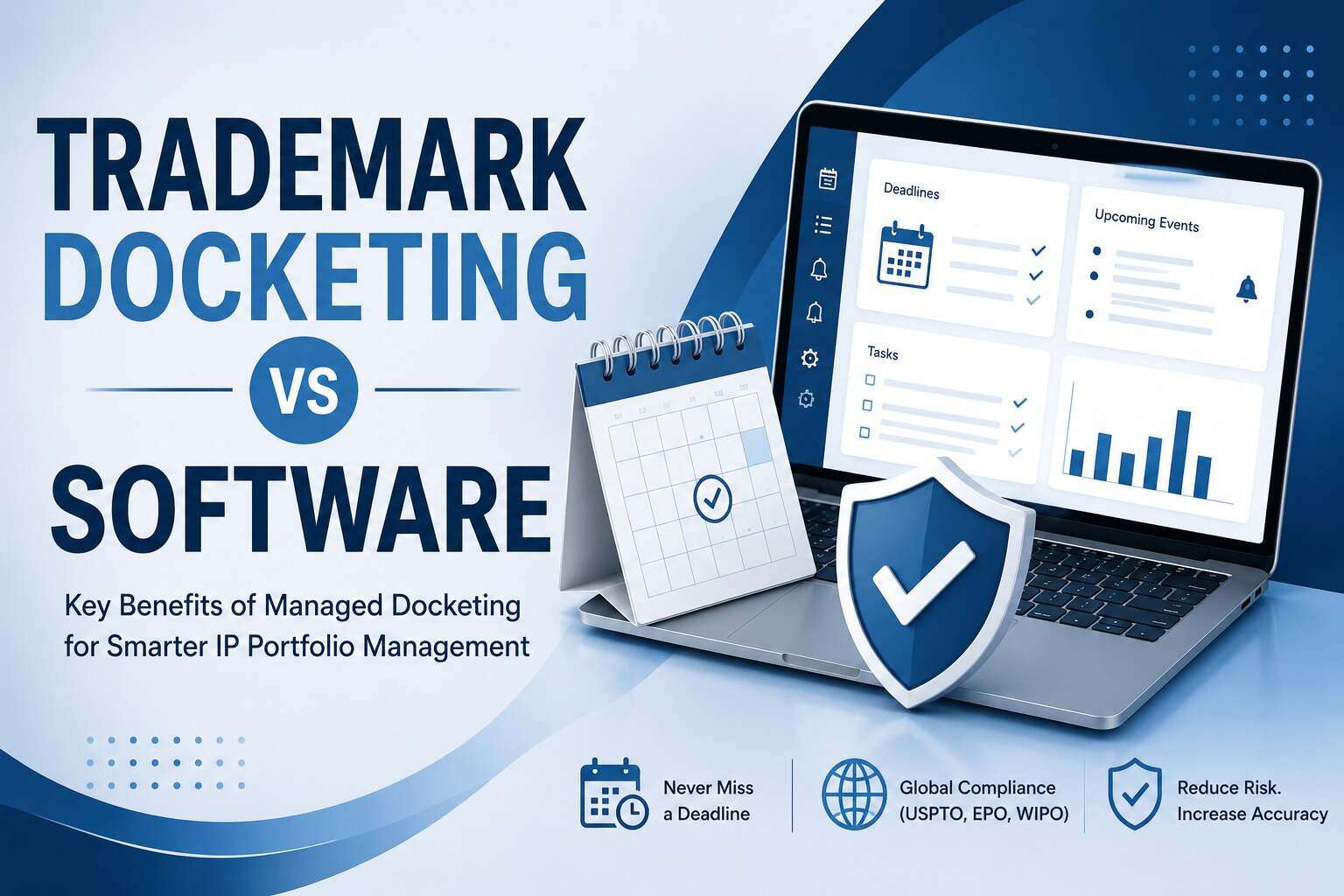
Trademark Docketing vs Software is an important consideration for law firms, corporations, and intellectual property teams managing growing trademark portfolios. While trademark docketing software can automate reminders, organize records, and centralize important information, managed trademark docketing adds something software alone cannot provide: experienced professionals who monitor, review, and manage critical trademark events.
As trademark portfolios expand across the USPTO, EPO, WIPO, and other international offices, relying only on spreadsheets, calendars, or automated software can create operational challenges. A managed docketing service combines technology with human oversight to help improve accuracy, accountability, and deadline management.
This guide explains the key benefits of managed trademark docketing and how it compares with relying primarily on software.
What Is Trademark Docketing?
Trademark docketing is the process of recording, tracking, reviewing, and managing important events associated with trademark applications and registrations.
These events can include:
- Trademark filing deadlines
- Office action response dates
- Renewal deadlines
- Declaration and maintenance deadlines
- Opposition and cancellation periods
- Assignment-related activities
- Examination deadlines
- International trademark deadlines
- Portfolio status updates
Effective docketing is not simply about putting dates into a calendar. A reliable docketing process should identify the required action, responsible person, applicable jurisdiction, supporting documents, and final completion status.
This makes Trademark Docketing vs Software an important strategic discussion for businesses that want to protect their intellectual property rights.
What Is Trademark Docketing Software?
Trademark docketing software is technology designed to help legal and IP teams manage trademark information and deadlines.
Depending on the platform, software may provide:
- Automated deadline reminders
- Centralized trademark records
- Document management
- Calendar functionality
- Task assignments
- Reporting tools
- Portfolio dashboards
- Workflow automation
- Email notifications
These features can make daily docket management more organized. Software can also reduce repetitive administrative work and give teams a centralized view of their trademark portfolio.
However, software primarily follows the information, rules, and workflows configured by its users. It does not automatically replace professional judgment.
That distinction is central to understanding Trademark Docketing vs Software.
What Is Managed Trademark Docketing?
Managed trademark docketing combines specialized professionals with docketing technology.
Instead of requiring an internal team to manage every docketing activity, a managed service provider supports the process by monitoring records, reviewing deadlines, updating information, identifying important events, and escalating matters when necessary.
The technology provides the infrastructure. Experienced docketing professionals provide the oversight.
This combination can be particularly valuable for organizations with large, international, or continuously changing trademark portfolios.
Trademark Docketing vs Software: What Is the Difference?
The primary difference in Trademark Docketing vs Software is human involvement.
Software can notify a user that a deadline is approaching. A managed docketing professional can review the deadline, verify the information, identify the required action, and escalate the matter to the appropriate legal professional.
For example, an automated system may display an upcoming office action response deadline. A managed docketing team can go further by checking the underlying record, confirming the event, updating the docket, and communicating the upcoming action according to the established workflow.
Therefore, Trademark Docketing vs Software should not necessarily be viewed as technology versus humans. Instead, it can be viewed as technology alone versus technology supported by professional expertise.
7 Benefits of Managed Trademark Docketing
1. Better Deadline Monitoring
Trademark deadlines can directly affect the maintenance and protection of intellectual property rights.
A missed deadline may lead to additional work, unnecessary costs, loss of procedural opportunities, or other legal complications.
Managed trademark docketing provides an additional layer of monitoring. Professionals can review upcoming deadlines, prioritize important matters, and escalate approaching dates.
This is one of the major advantages when evaluating Trademark Docketing vs Software.
2. Human Quality Control
Technology can process information quickly, but incorrect information can still produce incorrect results.
For example, if a date is entered incorrectly or an event is categorized improperly, automated reminders may be based on inaccurate data.
Managed docketing introduces human quality control into the process. Docketing specialists can review records, validate information, and identify potential inconsistencies.
This human review can make the overall docketing workflow more reliable.
3. Support for International Trademark Portfolios
International trademark management can become complicated because different intellectual property offices have different procedures and deadlines.
A business may have trademark matters involving the USPTO in the United States, the EPO in Europe for relevant intellectual property matters, and WIPO systems for international trademark protection.
Managing these matters requires consistent recordkeeping and careful attention to jurisdiction-specific requirements.
Managed docketing can provide centralized portfolio support while helping teams maintain visibility across multiple jurisdictions.
4. Reduced Administrative Work
Attorneys and in-house IP professionals often have limited time.
Maintaining docket records, checking deadlines, updating statuses, and following up on administrative matters can consume valuable working hours.
Managed trademark docketing can take over many of these operational activities.
This allows legal professionals to focus more on prosecution strategy, enforcement, licensing, portfolio development, and client relationships.
When considering Trademark Docketing vs Software, workload reduction should therefore be an important factor.
5. Scalable Portfolio Management
Trademark portfolios can grow rapidly.
New applications, acquisitions, international expansion, brand launches, and portfolio restructuring can all increase the volume of docketing work.
Software can help accommodate additional records, but additional records still require monitoring and maintenance.
Managed docketing provides professional support as the portfolio changes. This can make the approach more scalable for organizations experiencing growth.
6. Improved Accountability
A good docketing process should clearly establish:
What needs to happen?
When does it need to happen?
Who is responsible?
Has the action been completed?
Managed services can establish structured workflows for reminders, escalation, status tracking, and completion.
This creates greater accountability and makes it easier for legal teams to identify the current status of important trademark matters.
7. Business Continuity
Internal docketing can sometimes depend heavily on one employee or a small team.
Employee turnover, vacation, workload increases, or unexpected absences can affect continuity.
A managed docketing provider can provide a dedicated process and team structure that reduces dependence on individual employees.
This can help maintain consistent trademark portfolio management even when internal circumstances change.
Limitations of Relying Only on Software
Software is useful, but organizations should understand its limitations before choosing software-only docketing.
Data Accuracy Still Matters
Software cannot correct every mistake automatically. If incorrect information enters the system, the resulting reminders and reports may also be incorrect.
Rules Require Interpretation
Trademark procedures can involve jurisdiction-specific requirements. A software notification does not necessarily explain the legal significance of every event.
Human Follow-Up Is Still Necessary
A reminder does not complete a legal task. Someone must review the matter, take action, prepare documents, communicate with stakeholders, and confirm completion.
Software Requires Maintenance
Trademark databases and workflows must remain accurate and current. Someone must maintain records, update information, review exceptions, and manage changes.
These factors explain why Trademark Docketing vs Software is increasingly being considered as a service-model decision rather than simply a technology decision.
Is Managed Trademark Docketing Better Than Software?
There is no single answer for every organization.
For a small trademark portfolio with experienced internal staff, software may provide an effective way to organize records and deadlines.
For larger portfolios, international operations, or teams with limited administrative resources, managed trademark docketing can provide additional value.
The right approach depends on:
- Portfolio size
- Number of jurisdictions
- Internal staffing
- Deadline complexity
- Required reporting
- Budget
- Existing technology
- Risk tolerance
- Need for professional oversight
The most effective solution may also be a hybrid model, where professional docketing specialists use software to deliver a structured and technology-enabled service.
Managed Trademark Docketing and the USPTO, EPO, and WIPO
Trademark portfolio management becomes more demanding when businesses operate internationally.
The USPTO manages trademark registration and related proceedings in the United States. International trademark protection can also involve WIPO systems, while businesses operating across European markets must understand the appropriate European intellectual property framework.
Because procedures, deadlines, and documentation can vary, centralized recordkeeping is essential.
Managed trademark docketing can help organize these matters within a consistent workflow while providing professional monitoring and escalation.
Organizations should still rely on qualified legal professionals for legal advice and jurisdiction-specific decisions.
Why IP Brigade Services Can Help
IP Brigade provides intellectual property support services for law firms, corporations, and businesses that need reliable assistance with IP-related workflows.
Its service portfolio can support organizations with research, patent, trademark, and intellectual property operations.
IP Brigade Services Include:
- Novelty Search
- Patentability Search
- Freedom to Operate (FTO) Search
- Patent Invalidity Search
- Patent Landscape Studies
- Chemical Structure-Based Search
- Patent Drawings
- Intellectual Property Support Services
By combining professional expertise with structured processes and technology, IP Brigade can help legal teams manage demanding intellectual property workloads more efficiently.
Trademark Docketing vs Software: Questions to Ask Before Choosing
Before deciding between managed services and software, organizations should ask:
Who monitors the deadlines?
A system can generate reminders, but a managed service can provide professional monitoring and escalation.
Who validates the data?
Determine whether your internal team has enough time and expertise to continuously check docket records.
Who handles international matters?
Consider how your process manages USPTO, WIPO, EPO-related, and other international intellectual property activities.
What happens when staff are unavailable?
A reliable docketing process should have backup procedures.
Can the system scale?
Consider whether the solution can handle portfolio growth without creating additional administrative pressure.
These questions can make the Trademark Docketing vs Software decision much clearer.
The Future of Trademark Docketing
The future of trademark docketing is likely to involve greater automation, better data integration, artificial intelligence-assisted workflows, and stronger reporting capabilities.
However, automation does not eliminate the need for professional oversight.
As trademark portfolios become more complex, businesses will increasingly need systems that combine automated technology with experienced professionals.
This makes managed trademark docketing particularly relevant for organizations that want both efficiency and accountability.
Conclusion
The comparison of Trademark Docketing vs Software is ultimately about choosing the right level of support for your trademark portfolio.
Software can provide valuable automation, reminders, reporting, and centralized records. Managed trademark docketing adds professional review, deadline monitoring, quality control, escalation, and continuity.
For businesses managing growing portfolios across the USPTO, EPO, WIPO, and other jurisdictions, the combination of technology and experienced docketing professionals can provide a more comprehensive approach.
If your legal team is spending too much time maintaining trademark records and monitoring deadlines, managed docketing may help reduce administrative pressure while improving portfolio visibility.
IP Brigade can support organizations seeking professional intellectual property assistance and scalable docketing solutions tailored to their operational needs.