
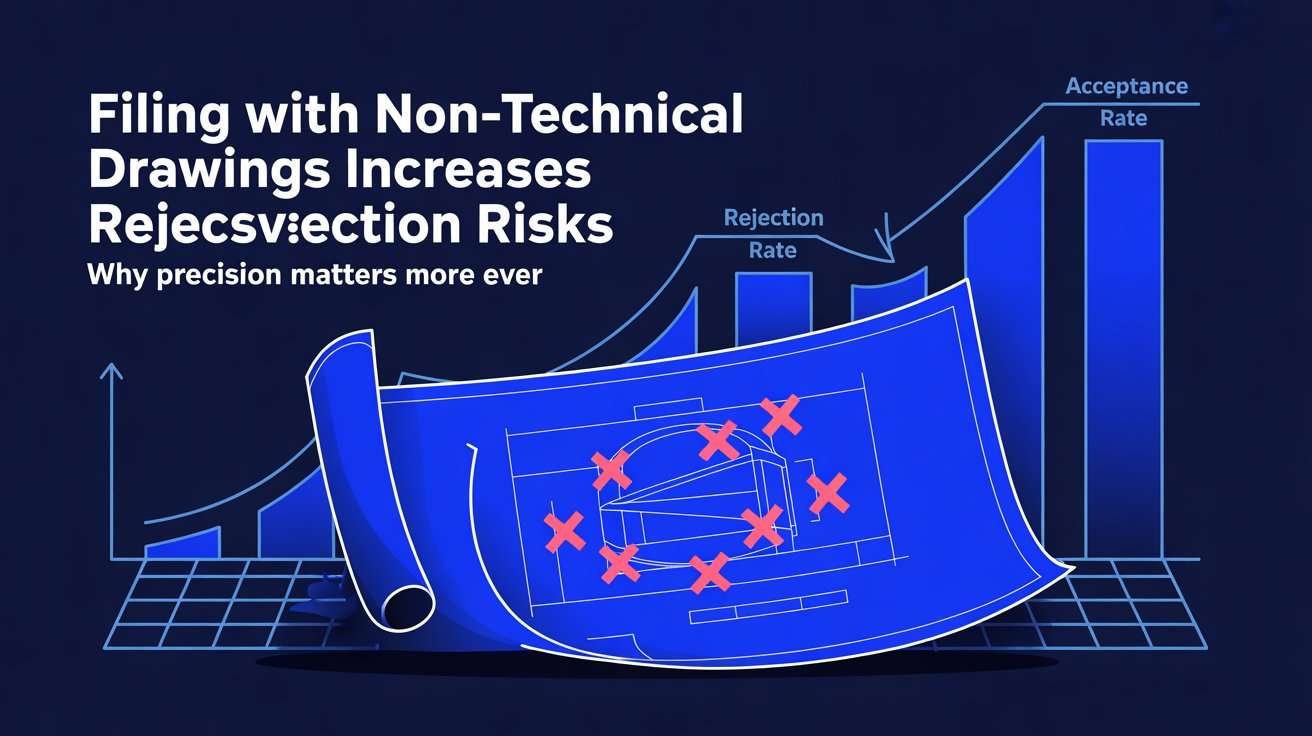
In the patent filing process, inventors often focus heavily on claims, specifications, and prior art searches—while unintentionally overlooking one of the most critical components of a successful application: Technical Drawing. Filing with non-technical drawing is one of the most common yet preventable reasons patent applications face formal objections, prolonged examination, or outright rejection.
Patent offices across the globe—including the United States Patent and Trademark Office (USPTO), the European Patent Office (EPO), and the World Intellectual Property Organization (WIPO)—treat drawings as legal disclosures, not visual aids. When drawings lack technical accuracy, examiners cannot properly evaluate novelty, clarity, or enablement. This significantly increases rejection risks.
This article explains why non-technical drawings are dangerous, how patent examiners evaluate Technical Drawings, and how inventors can strengthen their applications with the right technical and search support.
What Are Non-Technical Drawing in Patent Applications?
Non-technical drawing are illustrations that fail to meet patent-office standards for clarity, consistency, and disclosure. These may include:
- Hand-drawn sketches
- Marketing visuals or 3D renders
- Screenshots from CAD software without patent formatting
- Drawings missing reference numerals
- Illustrations created without understanding patent rules
While such images may explain an idea conceptually, they do not qualify as Technical Drawing under patent regulations.
According to the USPTO drawing requirements
drawings must be sufficiently detailed so that a person skilled in the art can understand the invention without interpretation or guesswork. Non-technical drawing rarely satisfy this requirement.
Why Patent Offices Depend on Technical Drawing
Patent examiners use Technical Drawing to:
- Verify that claims are supported
- Understand structural and functional relationships
- Assess novelty and inventive step
- Determine whether the invention is enabled
At the EPO
and under WIPO’s PCT framework
drawings play a vital role in examination across multiple jurisdictions. If drawings are unclear or inconsistent, examiners may issue objections before substantive examination even begins.
How Non-Technical Drawings Increase Rejection Risks
1. Lack of Clarity and Enablement
When drawings fail to show how components relate or function together, examiners cannot determine whether the invention is fully disclosed. This often results in clarity or enablement objections.
Proper Technical Drawing eliminate ambiguity by:
- Clearly labeling elements
- Showing relationships through multiple views
- Supporting the written specification
2. Mismatch Between Drawings and Specification
Non-technical drawings often do not align with the written description. Common issues include:
- Elements described in text but missing in drawings
- Features shown visually but not explained
- Inconsistent terminology or numbering
Patent offices expect one-to-one consistency. When drawings and specifications do not match, rejection risks increase significantly.
3. Missing or Incorrect Reference Numerals
Reference numerals are a core requirement of Technical Drawing. Non-technical illustrations frequently:
- Omit numerals
- Reuse numerals incorrectly
- Use numbers that do not match the specification
These errors force examiners to guess—something patent offices are not permitted to do.
Design vs Utility Patents: Different Risks, Same Problem
Both design and utility patents suffer when non-technical drawing are filed, but the consequences differ.
Design Patents
In design patents:
- Drawings define the entire scope of protection
- Any ambiguity limits enforceability
- Improper shading or perspective can invalidate claims
Submitting non-technical drawing in a design patent application almost guarantees objections.
Utility Patents
For utility patents, Technical Drawings must explain function and structure. Non-technical drawing may:
- Fail to support claims
- Create gaps in disclosure
- Limit claim scope later
In both cases, technical accuracy is essential.
Global Filing Risks Multiply Drawing Errors
Many applicants file internationally using a single priority application. If non-technical drawing are included initially:
- Errors carry into PCT filings
- National phase corrections may be restricted
- Multiple jurisdictions may raise similar objections
Patent offices worldwide expect Technical Drawings to meet formal standards from day one.
Why Startups and First-Time Inventors Are Most Vulnerable
Startups often:
- Try to save costs with DIY drawings
- Use product mockups instead of patent drawings
- Assume examiners will “understand the idea”
Unfortunately, patent examination is rule-driven, not intuitive. Many rejected applications reviewed by patent analysts show that weak drawings—not weak inventions—were the root cause.
Investors and partners also scrutinize patent quality. Poor Technical Drawings can reduce credibility and valuation.
The Hidden Cost of Filing with Non-Technical Drawings
While professional drawings may appear expensive initially, non-technical drawing often lead to:
- Multiple office actions
- Redrawing and amendment costs
- Delayed grant timelines
- Lost commercial opportunities
In many cases, fixing drawing errors later is limited by new-matter restrictions, making early mistakes permanent.
Best Practices for Patent-Compliant Technical Drawing
To reduce rejection risks, Technical Drawings should:
- Use clean black-and-white line work
- Follow USPTO, EPO, and WIPO formatting rules
- Include all claimed elements
- Use consistent reference numerals
- Provide multiple views where required
- Match the specification exactly
These practices significantly improve examiner comprehension and approval likelihood.
Strengthening Patent Filings Beyond Drawings
High-quality Technical Drawing work best when combined with strong search and analysis strategies. This is where professional IP services play a critical role.
How IP Brigade Supports Stronger Patent Filings
At IP Brigade
we help inventors, startups, and enterprises reduce patent risks through a combination of technical accuracy and strategic analysis, including:
- Novelty Search to assess patentability early
- Freedom to Operate (FTO) Search to identify infringement risks
- Patentability Search for informed filing decisions
- Patent Invalidity Search to challenge weak patents
- Patent Landscape Analysis for competitive intelligence
- Chemical Structure-Based Search for pharma and chemical innovations
- Design Patent Drawings and Utility Patent Drawings compliant with global standards
- Information Disclosure Statement (IDS) Preparation for USPTO compliance
By integrating professional Technical Drawings with robust patent searches, applicants can significantly reduce rejection risks and prosecution delays.
Examiner Perspective: Why Technical Drawing Signal Quality
From an examiner’s point of view, high-quality Technical Drawing indicate:
- Careful drafting
- Clear disclosure
- Strong claim support
Poor drawings suggest the opposite and often invite deeper scrutiny.
Clear drawings don’t just reduce objections—they speed up examination.
Final Thoughts: Non-Technical Drawings Are a Preventable Risk
Filing with non-technical drawing is one of the most avoidable causes of patent rejection. In today’s competitive and globally connected patent environment, Technical Drawing are no longer optional—they are foundational.
Inventors who invest in compliant drawings and strategic patent searches early are far more likely to secure enforceable, valuable patents.
The takeaway is simple:
Strong inventions deserve strong Technical Drawing and the right IP support to match.