
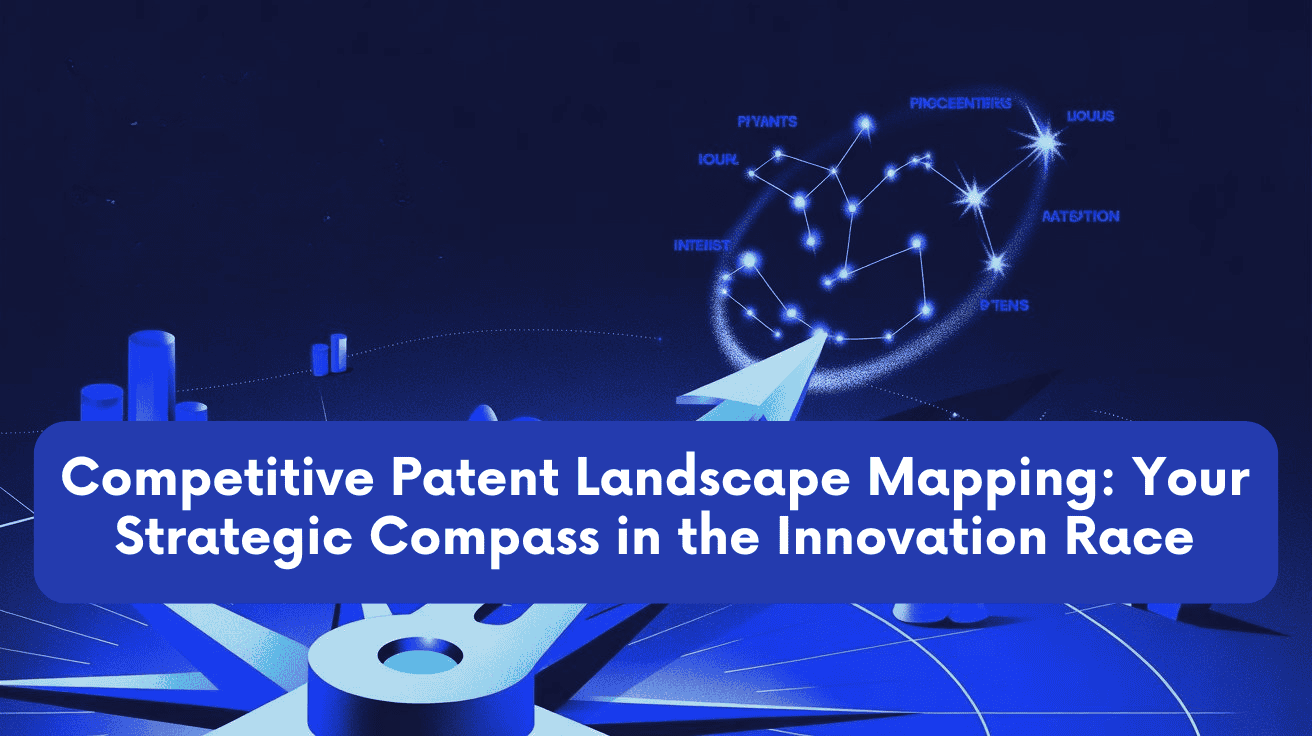
In today’s hyper-competitive global market, innovation is not just about creating the next big thing—it’s about navigating a complex maze of existing and emerging technologies. For companies, investors, and R&D teams, understanding this maze is paramount. This is where Competitive Patent Landscape Mapping emerges as an indispensable strategic tool. At IP Brigade, we don’t just see patents as legal documents; we see them as rich, dynamic data sets that tell the story of an industry’s past, present, and future. A well-crafted patent landscape map is the compass that guides your innovation journey, helping you avoid dead ends, identify open pathways, and outmaneuver the competition.
What is Competitive Patent Landscape Mapping?
At its core, Competitive Patent Landscape Mapping is a systematic process of collecting, analyzing, and visualizing patent data within a specific technology field, market, or around a particular competitor. It goes beyond a simple list of patents. It involves:
- Identification: Uncovering all relevant patents and published applications from key jurisdictions like the USPTO, EPO, and WIPO.
- Analysis: Categorizing patents by technology, assignee (company), inventor, legal status, filing trends, and geographic coverage.
- Visualization: Creating intuitive charts, graphs, and maps that reveal patterns, gaps, white spaces, and key players.
- Interpretation: Deriving actionable insights on market trends, competitor strategies, potential risks, and lucrative opportunities.
Think of it as creating a detailed topographic map for a mountain range. A simple list of peaks (patents) is useless for navigation. But a map showing the height, terrain, trails, and locations of other climbers (competitors) is invaluable for planning your unique and successful ascent.
Why is it Non-Negotiable for Modern Businesses?
The strategic value of a comprehensive patent landscape analysis cannot be overstated. Here’s how it empowers decision-makers:
- For R&D and Innovation Management:
- Identify Technology Gaps and White Spaces: Discover areas with little patent activity where your R&D investments could yield strong, protectable results.
- Avoid Reinventing the Wheel: Save millions in R&D costs by understanding what has already been patented and where the true innovation frontiers lie. This proactive step is far more efficient than discovering prior art late in the process during a standard Patentability Search.
- Inspire New Directions: Analyze adjacent technologies and convergence trends to spark novel, cross-disciplinary ideas.
- For Corporate Strategy and Business Development:
- Benchmark Against Competitors: Understand the patent portfolios of key players. Who is the leader? Who is emerging? What are their core focuses and strategic shifts?
- Inform M&A Decisions: Evaluate the strength and complementarity of a target company’s IP portfolio before an acquisition.
- Guide Market Entry: Assess the patent density and key IP holders in a new geographic market or product sector before committing resources.
- For Risk Mitigation and Freedom to Operate (FTO):
While a full Freedom to Operate (FTO) Search is a distinct, legally-focused service, the landscape map is its crucial first step. It highlights high-risk zones and potential patent thickets that could block your product’s path to market. At IP Brigade, our landscape service often informs and streamlines the subsequent deep-dive FTO analysis, ensuring you don’t invest in commercially unviable projects. Think of the landscape as the radar identifying storm systems, and the FTO as the detailed weather report for your specific flight path. - For Licensing and IP Monetization:
- Identify Potential Licensors or Licensees: Find companies that hold patents you need or that might need the technology you’ve developed.
- Strengthen Negotiation Position: Enter licensing discussions with a complete understanding of the broader patent environment and the relative value of assets.
The IP Brigade Methodology: Precision, Depth, and Insight
At IP Brigade, we transform raw patent data into strategic intelligence through a rigorous, multi-phase process:
Phase 1: Scoping & Definition
We begin by collaborating closely with you to define the boundaries. What is the precise technology? What are the key search terms and IPC/CPC classifications? Who are the target competitors? What geographic regions (USPTO, EPO, WIPO databases, etc.) and time frame are relevant?
Phase 2: Comprehensive Data Aggregation
Our experts use proprietary Boolean search strings and leverage advanced professional databases to cast a wide net. We ensure no relevant patent document from major offices is missed. This phase often overlaps with the thoroughness we apply in our Novelty Search and Patentability Search services, ensuring the dataset is both broad and deep.
Phase 3: Critical Cleaning & Categorization
Raw data is noisy. We deduplicate, standardize assignee names (accounting for subsidiaries and variations), and manually screen for relevance. Patents are then tagged into custom technology categories tailored to your project.
Phase 4: Advanced Analytics & Visualization
This is where the story unfolds. We analyze:
- Trend Analysis: Filing activity over time, signaling growing or declining interest.
- Assignee Ranking: Who has the largest portfolios? Who is most active recently?
- Inventor Networks: Identifying key innovators and collaborative patterns.
- Geographic Coverage: Where are companies seeking protection? (Using data from WIPO for PCT applications is key here).
- Citation Maps: Uncovering foundational patents and technology evolution pathways.
Phase 5: Insightful Reporting & Strategic Recommendations
We deliver more than just charts. Our final report provides a narrative—a strategic overview of the landscape, highlights of key players and patents, identification of white spaces and opportunity zones, and clear, actionable recommendations for your business.
Synergy with Core IP Brigade Services
A Competitive Patent Landscape Map is not an isolated service; it is the foundational intelligence that enhances the value of our other offerings:
- Informed Patentability Searches: Before investing in a Patentability Search, a landscape overview can quickly indicate if an area is too crowded or ripe for innovation, ensuring your R&D queries are well-directed.
- Targeted Freedom to Operate (FTO) Search: The landscape identifies high-risk competitors and patents, allowing our subsequent FTO Search to be highly focused and efficient, reducing cost and increasing precision.
- Chemical & Technical Precision: For fields like pharmaceuticals, agrochemicals, or advanced materials, our Chemical Structure-Based Search capability is integrated into the landscape process, allowing for exact structure and substructure searching—a critical differentiator.
- Stronger Patent Applications: Insights from a landscape can help draft broader, more defensible claims. Furthermore, when preparing the Information Disclosure Statement (IDS), a thorough landscape history ensures all relevant prior art is considered and cited, strengthening your application’s validity.
- Supporting the Entire Journey: From the initial idea (Landscape, Patentability Search) to securing rights (with the aid of our Utility and Design Patent Drawings team for impeccable illustrations) and maintaining them (IDS Preparation), we provide a seamless IP lifecycle support system.
Navigating the Global IP Terrain: USPTO, EPO, and WIPO
An effective landscape is inherently global. Our analysis always incorporates data from the world’s leading patent offices:
- The United States Patent and Trademark Office (USPTO): Essential for understanding the crucial US market and its innovators.
- The European Patent Office (EPO): Key for the European market and often a source of high-quality, multi-lingual technical documents.
- The World Intellectual Property Organization (WIPO): The gateway to the PCT system, WIPO’s Patentscope database is invaluable for tracking early-stage international filings and global patenting strategies.
By triangulating data from these sources, IP Brigade creates a truly world-view of your competitive environment.
Conclusion: Don't Navigate Blindfolded
In the race for innovation, guessing is a luxury you cannot afford. Competitive Patent Landscape Mapping provides the clarity, foresight, and strategic direction needed to make informed decisions, allocate resources wisely, and secure a defensible market position.
At IP Brigade, we combine expert analysts, advanced tools, and a client-centric approach to deliver landscape maps that are not just reports, but strategic assets. Let us help you chart your course to IP and commercial success.
Ready to map your path to leadership? Contact IP Brigade today for a consultation on your Competitive Patent Landscape Mapping project.
Frequently Asked Questions (FAQs)
Q1: How is a Patent Landscape different from a simple patent search?
A simple patent search, like a Novelty Search, aims to find specific prior art against a single invention. A Landscape is a broad, analytical study of all patents in a field. It focuses on trends, players, relationships, and macro-level insights, not just the existence of individual patents.
Q2: What’s the difference between a Landscape and a Freedom to Operate (FTO) analysis?
A Landscape is a strategic, bird’s-eye-view tool for planning. An FTO Search is a tactical, legal opinion focused on identifying patents that could specifically block you from making, using, or selling a defined product in a specific region. The landscape often precedes and scopes the FTO, making the latter more cost-effective.
Q3: How long does it take to create a comprehensive Patent Landscape Map?
The timeline depends on the technology scope and geographic breadth. A focused landscape might take 3-4 weeks, while a broad, multi-jurisdictional analysis for a complex field like biotechnology or telecommunications could take 6-8 weeks. IP Brigade provides clear timelines after the initial scoping discussion.
Q4: What do you deliver at the end of the project?
You receive a detailed professional report including an executive summary, methodology, all analytical charts and graphs (trends, top assignees, geographic maps, etc.), profiles of key patents and players, identification of white spaces, and strategic recommendations. We also typically provide the raw data set for your internal use.
Q5: Can you do landscapes for any technology area?
Yes. IP Brigade has experts and resources covering all major domains: mechanical, electrical, software, chemical, life sciences, and more. Our specialized Chemical Structure-Based Search capability is a particular strength for chemistry-related fields.
Q6: How often should a Patent Landscape be updated?
For fast-moving technologies (e.g., AI, CRISPR), an annual or bi-annual update is recommended. For more mature fields, an update every 2-3 years may suffice. We offer ongoing monitoring and update services to keep your strategic map current.
Q7: How does this help with patent drafting and application?
The landscape reveals how competitors claim their inventions, highlights common language, and identifies gaps. This informs your own claim strategy to seek broader, stronger protection. It also ensures your application is novel and non-obvious within the full context of the art, which our Patentability Search service then deeply validates. Furthermore, quality Patent Drawings and a proper Information Disclosure Statement are strengthened by the comprehensive understanding a landscape provides.