
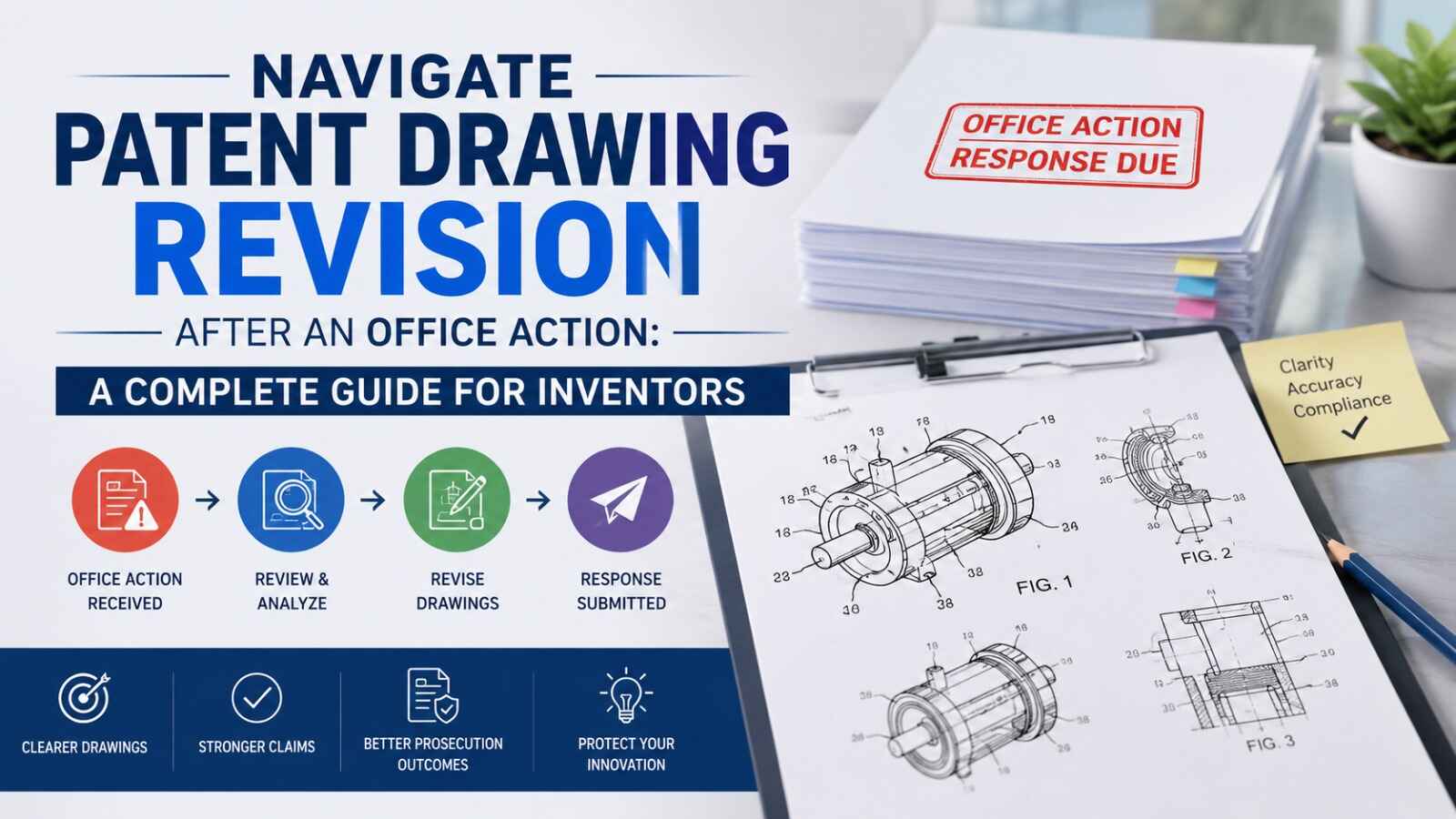
Receiving an Office Action from a patent office can feel discouraging, but it is actually a common part of the patent prosecution process. Many patent applications receive one or more Office Actions before they are approved. In many cases, the issue is not with the invention itself but with the patent drawings submitted alongside the application. This is where it becomes essential to Navigate Patent Drawing and Revision After an Office Action effectively.
Patent drawings are more than illustrations—they are legal documents that help patent examiners understand every aspect of your invention. If the drawings fail to meet patent office standards or accurately represent the claimed invention, an examiner may request revisions before allowing the application to proceed.
Understanding how to Navigate Patent Drawing and Revision After an Office Action can significantly improve your chances of obtaining a patent while avoiding unnecessary delays and expenses. Whether you are filing with the USPTO, WIPO, or EPO, professionally revised patent drawings can make a substantial difference in the outcome of your application.
At IP Brigade, our experienced professionals help inventors, startups, corporations, and patent attorneys revise patent drawings according to international patent office requirements, ensuring accuracy, compliance, and timely submission.
What Is an Office Action?
An Office Action is an official communication issued by a patent examiner during the examination process. It identifies objections, rejections, or requests for clarification that must be addressed before the patent application can proceed.
Office Actions may include:
- Drawing objections
- Specification objections
- Claim rejections
- Prior art citations
- Formal requirement corrections
Among these, drawing objections are surprisingly common because patent offices have strict formatting and illustration requirements.
Learning how to Navigate Patent Drawing and Revision After an Office Action ensures these objections are resolved efficiently.
Why Patent Drawings Matter
Patent drawings communicate technical information that words alone cannot explain.
They help examiners understand:
- Product structure
- Mechanical components
- Internal assemblies
- Functional relationships
- Design features
- Manufacturing details
Poor quality drawings often create confusion that can delay examination.
Properly prepared illustrations help applicants successfully Navigate Patent Drawing and Revision After an Office Action with fewer complications.
Common Drawing Objections in an Office Action
Patent examiners frequently object to drawings because they fail to comply with official requirements.
Common issues include:
Missing Views
Required views may include:
- Front
- Rear
- Left
- Right
- Top
- Bottom
- Perspective
- Cross-sectional
Missing even one important view may result in an objection.
Incorrect Line Types
Patent offices require:
- Solid lines
- Broken lines
- Boundary lines
- Section lines
Improper use of these line styles can cause examination delays.
Poor Image Quality
Common problems include:
- Low resolution
- Pixelated images
- Blurry scans
- Uneven line weights
- Dark backgrounds
Professional redrawing eliminates these issues.
Reference Number Errors
Reference numerals must:
- Match the specification
- Be readable
- Remain consistent
- Avoid overlapping lines
Incorrect numbering often requires revisions.
Improper Margins
Patent offices specify exact page margins.
Incorrect formatting may trigger formal objections.
Inconsistent Views
All figures must consistently represent the invention.
Differences between figures often lead to Office Actions.
Understanding these common issues helps applicants Navigate Patent Drawing and Revision After an Office Action much more effectively.
Why Drawing Revisions Should Never Be Ignored
Many applicants underestimate drawing objections.
However, ignoring them can lead to:
- Longer prosecution
- Additional Office Actions
- Increased attorney costs
- Missed deadlines
- Patent abandonment
Timely revisions help applicants Navigate Patent Drawing and Revision After an Office Action without jeopardizing their filing.
How Professional Patent Drawing Revision Helps
Professional patent illustrators understand patent office standards thoroughly.
They ensure:
- Proper formatting
- Correct line quality
- Accurate proportions
- Complete figure sets
- Specification consistency
This expertise makes it easier to Navigate Patent Drawing and Revision After an Office Action while reducing examiner concerns.
Steps to Navigate Patent Drawing and Revision After an Office Action
Step 1: Review the Examiner’s Comments
Carefully read every drawing objection.
Determine whether the issue involves:
- Missing figures
- Formatting
- Labels
- Clarity
- Compliance
This forms the foundation to Navigate Patent Drawing and Revision After an Office Action successfully.
Step 2: Compare Drawings with the Specification
Every figure should accurately support the written disclosure.
Look for:
- Missing components
- Incorrect numbering
- View inconsistencies
- Unsupported features
Consistency is essential.
Step 3: Revise the Drawings
Professional revisions may include:
- Redrawing figures
- Adding missing views
- Correcting labels
- Improving line quality
- Adjusting proportions
- Correcting margins
These improvements help applicants confidently Navigate Patent Drawing and Revision After an Office Action.
Step 4: Verify Patent Office Standards
Each patent office has unique drawing requirements.
Professional illustrators ensure compliance before submission.
Step 5: Submit Corrected Drawings
Once revisions are complete, updated drawings accompany the Office Action response.
Complete and accurate submissions reduce the likelihood of further objections.
Patent Offices with Strict Drawing Requirements
Major patent offices maintain comprehensive drawing standards.
USPTO
The United States Patent and Trademark Office requires:
- Black-and-white line drawings
- Standard page sizes
- Proper margins
- Uniform line thickness
- Clear reference numerals
WIPO
International PCT applications require:
- Consistent formatting
- Legible illustrations
- Accurate figure numbering
- Proper reproduction quality
EPO
The European Patent Office emphasizes:
- Technical clarity
- High-quality line drawings
- Proper scaling
- Consistent formatting
Meeting these standards helps inventors Navigate Patent Drawing and Revision After an Office Action efficiently across jurisdictions.
Utility Patent Drawing Revisions
Utility patent drawings often involve complex technical illustrations.
Common revisions include:
- Mechanical assemblies
- Electronic circuits
- Flowcharts
- Process diagrams
- Exploded views
- Cross-sectional views
Professional revisions improve examiner understanding.
Design Patent Drawing Revisions
Design patents rely heavily on visual disclosure.
Even small inconsistencies may result in objections.
Professional revisions focus on:
- Surface contours
- Broken lines
- Environmental structures
- Shading consistency
- Multiple perspectives
This makes it easier to Navigate Patent Drawing and Revision After an Office Action for design applications.
Benefits of Professional Patent Drawing Services
Professional illustration services provide numerous advantages.
Higher Accuracy
Experienced illustrators understand patent office expectations.
Faster Responses
Quick revisions help applicants meet Office Action deadlines.
Better Compliance
Professional drawings reduce examiner objections.
Cost Savings
Avoiding repeated Office Actions lowers prosecution costs.
Improved Patent Quality
Accurate drawings strengthen the overall application.
Why Choose an IP Brigade?
IP Brigade provides comprehensive intellectual property support beyond patent illustrations.
Our experienced professionals combine technical expertise with patent knowledge to deliver drawings that comply with international standards.
Clients choose IP Brigade because we offer:
- Experienced patent illustrators
- Fast turnaround times
- Affordable pricing
- Confidential handling
- Global patent support
- High-quality technical illustrations
Whether your application involves utility patents, design patents, or international filings, IP Brigade helps clients confidently Navigate Patent Drawing and Revision After an Office Action.
Best Practices to Avoid Future Drawing Objections
Applicants can reduce future revisions by following several best practices.
Hire Professional Patent Illustrators
Experts understand official drawing requirements.
Verify Every Figure
Check consistency before filing.
Maintain Specification Alignment
Ensure every drawing matches the written description.
Follow Patent Office Standards
Review submission requirements carefully.
Respond Quickly
Prompt revisions help avoid unnecessary delays.
These practices make it much easier to Navigate Patent Drawing and Revision After an Office Action while improving the chances of patent approval.
The Value of Early Professional Support
Many drawing objections could have been avoided through professional preparation before filing.
Working with experienced patent illustration specialists offers:
- Fewer corrections
- Better examiner understanding
- Faster examination
- Reduced legal costs
- Stronger patent applications
Investing in quality drawings early simplifies every stage of prosecution.
Conclusion
Receiving an Office Action is not the end of the patent process it is an opportunity to strengthen your application. Drawing objections are among the most common issues raised by patent examiners, but they can usually be resolved through careful review and professional revisions.
Knowing how to Navigate Patent Drawing and Revision After an Office Action enables inventors, businesses, and patent professionals to respond effectively, maintain compliance with patent office requirements, and keep applications moving toward approval.
Professional patent drawing revisions improve clarity, eliminate formatting errors, and ensure consistency across every figure. Whether filing with the USPTO, WIPO, or EPO, accurate illustrations remain an essential component of successful patent prosecution.
With experienced technical illustrators and comprehensive intellectual property solutions, IP Brigade helps innovators confidently Navigate Patent Drawing and Revision After an Office Action, ensuring high-quality patent drawings that meet global standards and support successful patent applications.
Need expert assistance to Navigate Patent Drawing and Revision After an Office Action?
IP Brigade provides end-to-end intellectual property support to help inventors, startups, enterprises, and patent professionals protect their innovations with confidence.
Our services include:
- Patent Drawings
- Novelty Search
- Freedom to Operate Search
- Patent Invalidity Search
- Patentability Search
- Patent Landscape Studies
- Chemical Structure-based Search
Partner with IP Brigade to ensure your patent application meets international standards, responds effectively to Office Actions, and moves smoothly toward successful patent protection.