
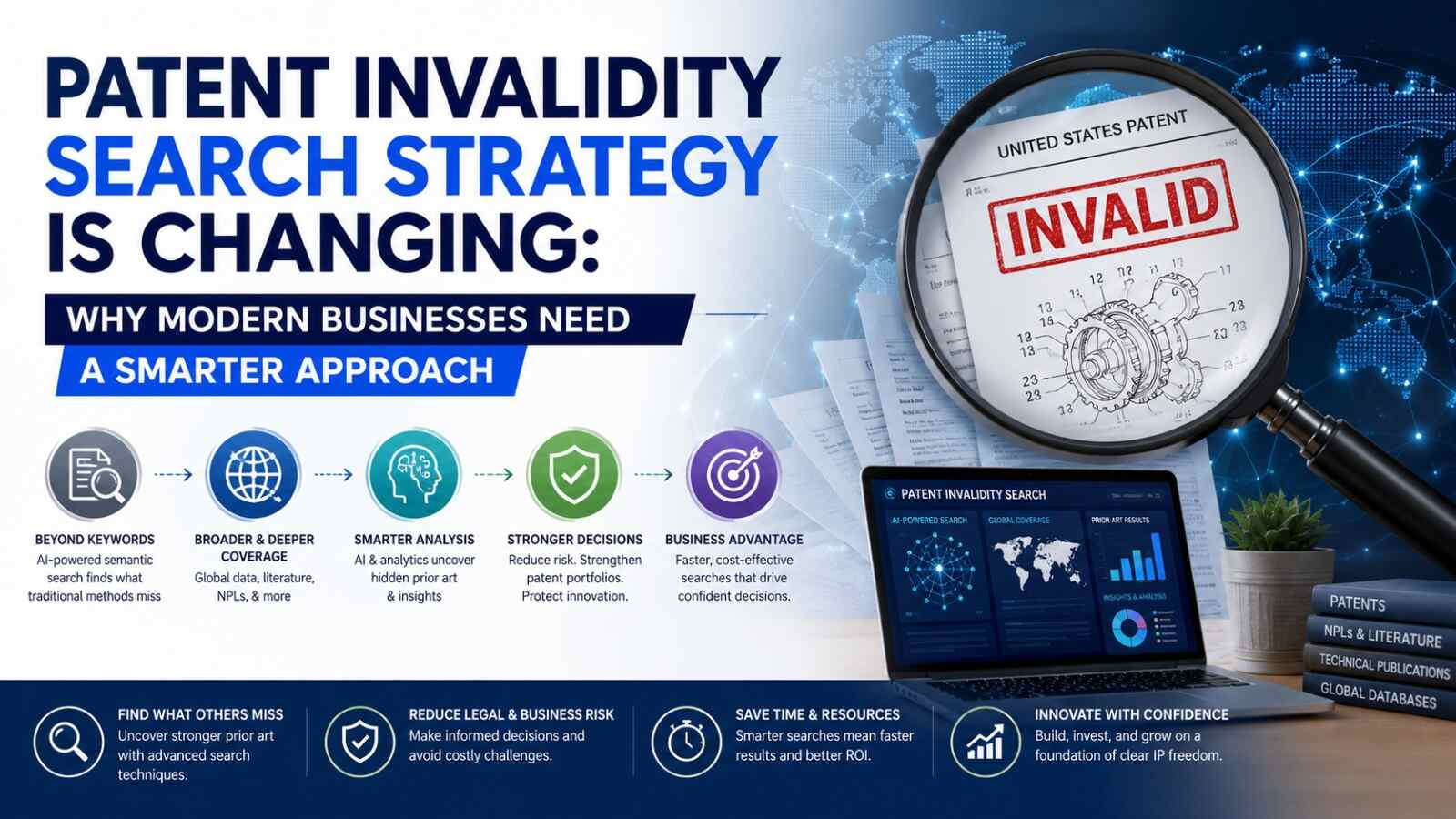
The patent landscape is evolving rapidly. Every year, millions of patent documents, technical publications, and research papers are added to public databases, making patent validation more challenging than ever. In this environment, a traditional search approach is no longer enough. A modern Patent Invalidity Search Strategy has become an essential part of protecting businesses from costly patent disputes and defending against infringement claims.
Whether you are a patent attorney, an innovator, a startup founder, or an established company, investing in a comprehensive Patent Invalidity Search Strategy can significantly strengthen your legal position. Instead of relying only on patent databases, today’s strategy combines global patent records, scientific literature, industry publications, archived web content, and technical documentation to uncover prior art that may invalidate an issued patent.
At IP Brigade, we help businesses and law firms develop an effective Patent Invalidity Search Strategy that identifies strong prior art and supports litigation, licensing negotiations, patent oppositions, and business decisions.
What Is a Patent Invalidity Search Strategy?
A Patent Invalidity Search Strategy is a structured process used to locate evidence showing that an issued patent should not have been granted because the invention was already publicly known before its filing date.
The goal is to discover prior art that demonstrates a patent claim lacks novelty or would have been obvious to someone skilled in the relevant technical field.
An effective Patent Invalidity Search Strategy goes far beyond keyword searching. It involves understanding patent claims, identifying technical concepts, selecting the right databases, and reviewing both patent and non-patent literature.
Why Patent Invalidity Search Strategy Is Changing
Patent research has changed dramatically over the last decade. Earlier, researchers focused mainly on patent databases. Today, valuable prior art is scattered across numerous sources that require advanced search techniques.
Several factors have transformed the way professionals conduct a Patent Invalidity Search Strategy.
The Growth of Global Innovation
Inventors now file patents across multiple countries. A document published in Europe or Asia may invalidate a patent granted in the United States. This is why global searching has become an essential part of every Patent Invalidity Search Strategy.
Expansion of Non-Patent Literature
Many innovations first appear in conference proceedings, engineering journals, university research papers, technical standards, product manuals, and online publications rather than patent applications. Ignoring these resources may result in missing critical evidence.
More Complex Patent Claims
Modern patents often include broad and technically sophisticated claims. Identifying relevant prior art requires a deeper understanding of technical terminology, classifications, and claim interpretation.
Artificial Intelligence Is Improving Searches
AI powered search platforms can analyze millions of documents in minutes, identify similar concepts, and suggest relevant references. However, technology alone cannot replace experienced patent professionals who understand legal claim interpretation.
Why Every Business Needs a Strong Patent Invalidity Search Strategy
A professional Patent Invalidity Search Strategy is valuable in many business situations.
Companies use invalidity searches to:
- Defend against patent infringement lawsuits
- Challenge competitor patents
- Support licensing negotiations
- Reduce litigation expenses
- Strengthen post-grant proceedings
- Evaluate acquisition opportunities
- Assess patent portfolio quality
Finding one overlooked piece of prior art can completely change the outcome of a patent dispute.
Key Elements of an Effective Patent Invalidity Search Strategy
Comprehensive Claim Analysis
Every successful Patent Invalidity Search Strategy begins with carefully reviewing the patent claims.
Researchers identify:
- Essential technical features
- Independent claims
- Dependent claims
- Technical terminology
- Functional limitations
- Earliest priority date
A detailed claim analysis ensures the search focuses on finding truly relevant prior art.
Worldwide Patent Database Research
An effective Patent Invalidity Search Strategy should never be limited to one country’s patent office.
Professional researchers investigate patents filed through major international patent authorities, including:
- USPTO (United States Patent and Trademark Office)
- EPO (European Patent Office)
- WIPO (World Intellectual Property Organization)
Searching across jurisdictions increases the likelihood of finding earlier disclosures.
Non-Patent Literature Review
Many groundbreaking technologies are published long before patent applications are filed.
A modern Patent Invalidity Search Strategy includes reviewing:
- Scientific journals
- Engineering publications
- Research papers
- White papers
- Industry magazines
- Technical standards
- Product manuals
- Conference proceedings
- University publications
Non-patent literature frequently contains highly valuable prior art.
Product History Investigation
Commercial products can also qualify as prior art if they were publicly available before the patent’s filing date.
Researchers examine:
- Product brochures
- Sales catalogs
- User manuals
- Technical specifications
- Archived websites
- Product launch announcements
- Demonstration videos
Including commercial evidence strengthens a Patent Invalidity Search Strategy.
Classification-Based Searching
Patent professionals combine keywords with patent classification systems to identify documents that use different technical terminology but describe the same invention.
Classification searching improves search accuracy while reducing irrelevant results.
Common Challenges During Patent Invalidity Searches
A successful Patent Invalidity Search Strategy requires overcoming several challenges.
These include:
- Multiple filing jurisdictions
- Foreign-language patents
- Broad patent claims
- Similar technical terminology
- Hidden non-patent literature
- Massive patent databases
- Patent family variations
Professional search methodologies help address these complexities efficiently.
The Importance of USPTO, EPO, and WIPO
Reliable patent research depends on trusted global resources.
The USPTO provides access to U.S. patents, published applications, assignments, and prosecution histories that are valuable for identifying earlier disclosures.
The EPO offers worldwide patent collections through Espacenet, allowing researchers to explore millions of patent documents across multiple jurisdictions.
The WIPO database includes international Patent Cooperation Treaty (PCT) applications, making it an important resource for global prior art searches.
Using these authoritative databases strengthens the quality of every Patent Invalidity Search Strategy.
How AI Supports a Patent Invalidity Search Strategy
Artificial intelligence has become a valuable research assistant.
Modern search platforms can:
- Identify similar inventions
- Suggest related terminology
- Translate foreign-language documents
- Analyze citations
- Group technically related publications
- Detect semantic similarities
However, AI cannot determine legal relevance on its own. Human expertise remains essential for interpreting claims and evaluating whether prior art anticipates an invention.
The best Patent Invalidity Search Strategy combines advanced technology with experienced patent analysts.
Best Practices for Building a Successful Patent Invalidity Search Strategy
Businesses should follow these proven practices.
Start with the Patent Claims
Understand exactly what the patent protects before beginning the search.
Search Globally
Limiting research to one country may overlook critical references.
Include Non-Patent Literature
Many invalidating disclosures are published outside patent databases.
Use Multiple Search Techniques
Combine keyword, classification, citation, semantic, and inventor-based searches.
Review Historical Products
Commercial products and public demonstrations often qualify as prior art.
Validate Every Reference
Each document should be carefully analyzed against the patent claims before being used in legal proceedings.
Why Businesses Trust IP Brigade
At IP Brigade, we understand that every patent dispute requires a customized research approach rather than a one-size-fits-all search.
Our experienced intellectual property professionals develop a tailored Patent Invalidity Search Strategy based on the technology, jurisdiction, litigation objectives, and client requirements.
Our approach includes:
- Comprehensive claim analysis
- Worldwide patent database research
- Non-patent literature searches
- Patent family analysis
- Citation mapping
- Technical document review
- Detailed search reports
- Confidential handling of every project
We focus on delivering accurate and defensible prior art that supports informed business and legal decisions.
Frequently Asked Questions
What is a Patent Invalidity Search Strategy?
A Patent Invalidity Search Strategy is a systematic process used to locate earlier publications or public disclosures that demonstrate an issued patent is not valid because its claims were already known or obvious before the filing date.
When should a Patent Invalidity Search be performed?
It is commonly conducted before patent litigation, licensing negotiations, patent oppositions, inter parts reviews, mergers and acquisitions, or when evaluating competitor patents.
Why is non-patent literature important?
Technical papers, journals, conference publications, standards, manuals, and product documentation often contain prior art that patent databases do not include.
Can international patents invalidate a U.S. patent?
Yes. Public disclosures from other countries may qualify as prior art if they were available before the patent’s priority date.
Why hire professionals for a Patent Invalidity Search Strategy?
Professional researchers understand claim interpretation, search methodologies, patent classifications, and technical analysis, increasing the chances of finding strong invalidating evidence.
Conclusion
As innovation accelerates and global patent filings continue to increase, businesses can no longer rely on outdated search methods. A modern Patent Invalidity Search Strategy combines worldwide patent databases, non-patent literature, classification analysis, technical expertise, and advanced search technologies to uncover the strongest prior art.
Whether you are preparing for litigation, challenging a competitor’s patent, or assessing business risk, investing in a professional Patent Invalidity Search Strategy can save significant time, money, and legal expense while strengthening your intellectual property position.
Partner with IP Brigade for Reliable Patent Research
A strong patent strategy begins with accurate research. IP Brigade provides comprehensive intellectual property search solutions designed to help innovators, corporations, research organizations, and law firms make informed decisions with confidence.
Our specialized services include:
- Novelty Search
- Freedom to Operate Search
- Patent Invalidity Search
- Patentability Search
- Patent Landscape Studies
- Chemical Structure-based Search
- Patent Drawings
Whether you need to evaluate an invention, challenge an issued patent, minimize infringement risks, or strengthen your IP portfolio, IP Brigade delivers reliable, confidential, and high-quality patent research tailored to your business goals.