

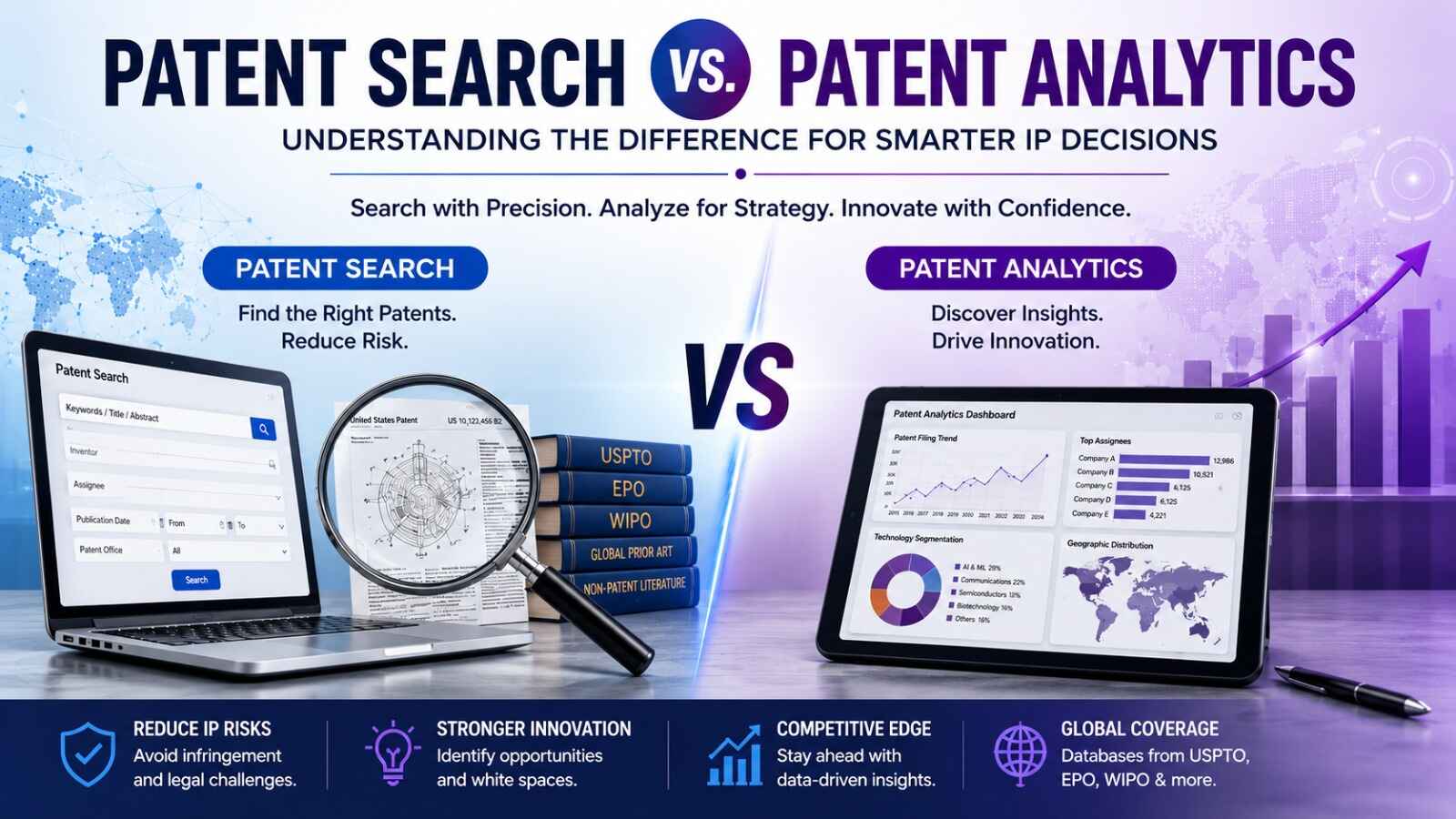
Patent Search vs Patent Analytics: Understanding the Difference for Smarter Intellectual Property Decisions
Innovation is the backbone of every successful business, but protecting that innovation requires more than simply filing a patent application. Before investing in research and development, companies must understand existing technologies, evaluate competitors, and identify opportunities for future growth. This is where understanding Patent Search vs Patent Analytics becomes essential.
Although these two terms are often used together, they serve different purposes. A patent search helps identify specific patent documents related to an invention, while patent analytics examines large collections of patent data to reveal technology trends, competitor activities, and business opportunities. Knowing the difference between Patent Search vs Patent Analytics allows inventors, startups, patent attorneys, and enterprises to make informed intellectual property decisions while reducing legal and financial risks.
At IP Brigade, we provide professional patent search and analytics solutions that help businesses protect their innovations and develop effective intellectual property strategies. By combining technical expertise with comprehensive research, we enable organizations to make smarter business decisions based on reliable patent intelligence.
What Is a Patent Search?
A patent search is the process of examining published patent applications, granted patents, and relevant non-patent literature to identify existing inventions or technologies related to a specific idea. The main objective is to determine whether an invention is new, identify prior art, or evaluate potential infringement risks before filing a patent application or launching a product.
Understanding Patent Search vs Patent Analytics starts with recognizing that a patent search focuses on answering specific legal and technical questions. It helps businesses avoid investing in inventions that already exist while improving the quality of patent applications.
Some of the most common patent searches include:
- Novelty Search – Determines whether an invention is unique by identifying similar technologies.
- Patentability Search – Evaluates whether an invention meets patentability requirements such as novelty and inventive step.
- Freedom to Operate (FTO) Search – Identifies active patents that could affect the commercialization of a product.
- Patent Invalidity Search – Finds prior art that may challenge the validity of an existing patent during litigation or licensing.
Professional patent searches are typically conducted using trusted databases maintained by the USPTO, EPO, and WIPO, ensuring global patent coverage and reliable search results.
What Is Patent Analytics?
While a patent search focuses on finding individual patent documents, patent analytics examines thousands of patent records to uncover valuable business insights. This is one of the biggest differences in Patent Search vs Patent Analytics.
Patent analytics uses patent data to identify technology trends, competitor strategies, filing patterns, innovation hotspots, and market opportunities. Instead of focusing on one invention, it provides a broader view of an entire technology sector.
For example, a company planning to develop electric vehicle technology can use patent analytics to identify leading innovators, analyze patent filing trends, and discover areas where innovation is still limited. These insights help organizations allocate research budgets more effectively and develop stronger innovation strategies.
Patent analytics often includes technology landscape studies, citation analysis, patent family analysis, inventor analysis, competitive benchmarking, and geographic filing trends. These reports enable businesses to make strategic decisions based on real-world patent data rather than assumptions.
Patent Search vs Patent Analytics: Key Differences
Understanding Patent Search vs Patent Analytics is easier when comparing their objectives.
A patent search is designed to answer specific questions about an invention. It identifies relevant patents, determines novelty, supports patent filing, and reduces infringement risks. The final output is a detailed search report containing relevant prior art and technical references.
Patent analytics, on the other hand, evaluates thousands of patents to reveal industry trends, emerging technologies, competitor activities, and innovation opportunities. Instead of producing a simple search report, it delivers strategic insights through charts, technology maps, and analytical dashboards.
Rather than choosing between Patent Search vs Patent Analytics, businesses should recognize that both approaches complement each other. Patent searches provide the legal foundation for protecting inventions, while patent analytics helps organizations make informed research, investment, and business decisions.
How Patent Search and Patent Analytics Work Together
The debate around Patent Search vs Patent Analytics should not be about choosing one over the other. Both play important roles in building a strong intellectual property strategy. A patent search provides legal and technical clarity, while patent analytics offers business intelligence that supports long-term innovation and growth.
For example, a startup developing a new software platform may first conduct a Novelty Search to determine whether the invention is unique. Next, a Patentability Search helps evaluate whether the innovation meets patent protection requirements. Before launching the product, a Freedom to Operate (FTO) Search identifies existing patents that could create infringement risks.
Once these searches are complete, patent analytics helps the company understand competitor filing trends, emerging technologies, and potential market opportunities. This combination enables businesses to protect their inventions while making smarter investment and research decisions.
Large organizations also use both approaches to strengthen their patent portfolios. Patent searches ensure each invention has a strong legal foundation, while patent analytics supports technology forecasting, licensing decisions, and competitive benchmarking. Together, they provide a complete picture of the intellectual property landscape.
Why Patent Intelligence Matters
Innovation is growing rapidly across industries such as artificial intelligence, biotechnology, pharmaceuticals, renewable energy, electronics, and automotive engineering. Thousands of new patent applications are filed every day, making it increasingly difficult for businesses to stay ahead of competitors without reliable patent intelligence.
Understanding Patent Search vs Patent Analytics helps organizations make data-driven decisions. Patent searches reduce the risk of duplicate research, improve patent application quality, and minimize infringement issues. Patent analytics identifies innovation trends, competitor strategies, technology gaps, and future research opportunities that can influence business growth.
Patent intelligence also supports mergers and acquisitions, technology licensing, investment decisions, and portfolio management. Companies and investors frequently analyze patent portfolios before making strategic business decisions. Reliable information from global patent databases maintained by the USPTO, EPO, and WIPO helps organizations confidently plan their innovation strategies.
Why Businesses Choose IP Brigade
At IP Brigade, we help businesses transform patent information into valuable business intelligence. Our experienced team delivers accurate patent research and analytics services tailored to inventors, startups, law firms, research institutions, and multinational companies.
Our services include:
- Novelty Search to determine whether an invention is new.
- Patentability Search to evaluate the likelihood of obtaining patent protection.
- Freedom to Operate Search to identify patents that could impact product commercialization.
- Patent Invalidity Search to locate prior art that may challenge existing patents.
- Patent Landscape Studies to analyze technology trends, leading innovators, and market opportunities.
- Chemical Structure-based Search for pharmaceutical and chemical innovations requiring structure-based patent analysis.
- Patent Drawings prepared according to the filing standards of the USPTO, EPO, and WIPO, ensuring high-quality illustrations for patent applications.
Every project is handled with strict confidentiality, technical accuracy, and a commitment to delivering actionable results that support business growth.
Conclusion
Understanding Patent Search vs Patent Analytics is essential for organizations that want to protect innovation while making informed business decisions. Although both rely on patent information, they serve different purposes. Patent searches focus on identifying prior art, evaluating patentability, and reducing infringement risks, whereas patent analytics transforms large patent datasets into strategic insights that support research, investment, and competitive planning.
Instead of viewing Patent Search vs Patent Analytics as separate solutions, businesses should combine both to create a stronger intellectual property strategy. Patent searches provide the legal confidence needed before filing patents or launching products, while patent analytics helps identify technology trends, competitor activities, and future opportunities. Together, they enable organizations to innovate with confidence and maintain a competitive advantage.
At IP Brigade, we provide comprehensive patent intelligence services designed to help businesses protect their innovations and achieve long-term success. Whether you require a Novelty Search, Patentability Search, Freedom to Operate Search, Patent Invalidity Search, Patent Landscape Studies, Chemical Structure-based Search, or professional Patent Drawings, our experts deliver reliable, accurate, and cost-effective solutions tailored to your business goals. Partner with IP Brigade to make smarter intellectual property decisions and turn innovation into a lasting competitive advantage.